
For a long time historians have been more interested in the stories of royals, nobles, knights and other important and powerful people, than they have been in the lives of the common folk.
But I’ve always cared more about what life was like for people like me, not rich, not powerful, not living in palaces, etc.
The book ‘Urban Women: Life, Love, and Work in the Medieval Low Countries’ (original title ‘Wijvenwereld’) does not just debunk a whole bunch of myth about medieval women and their roles in medieval society but also about the middle ages in general.
As I read it the image of women then having little power and barely playing a role evaporated.
I can highly recommend this book and will in this review share some of the most interesting things I found.
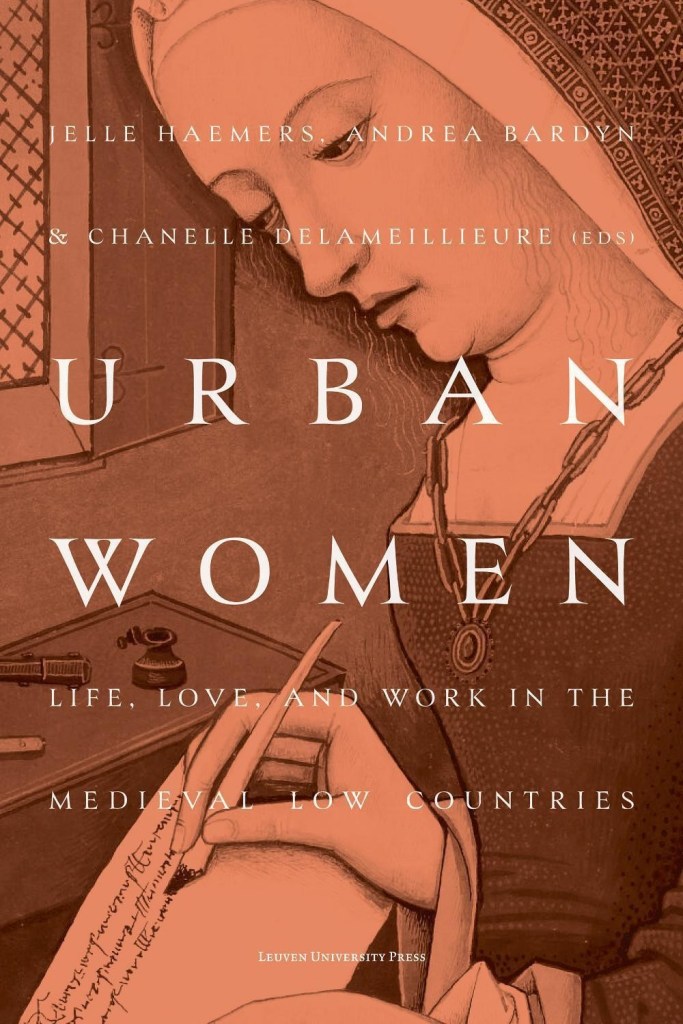
The book is full of little glimpses into the lives of people that otherwise would have been lost in the mists of time.
Like this very intimate story about an unmarried couple with children:
“On 28 May 1459, Jan De Custere and Katelijne Buelens went to Leuven Town Hall to inform the aldermen of decisions they had reached by common accord. Two children, a boy and a girl, had been born of their relationship. Jan and Katelijne were not united by the bonds of matrimony, however, and no longer lived under the same roof. This situation caused a problem: who was henceforth to look after the children? Jan lived in the countryside, in Kortelke (present-day Kortrijk-Dutsel, northeast of Leuven), while Katelijne lived in Leuven with the two children called Hanneken and Grietkin. In this case, the children had probably been baptized Johannes and Margriete, which their parents had turned into children’s common pet names, resulting respectively in Hanneken and Grietkin, as in the fairytale Hansel and Gretel. Yet these two children did not seem predisposed to a happy ending. As their parents were not married, Hanneken and Grietkin belonged to the unenviable class of illegitimate children.
Thus their respective futures did not augur well, for children born out of wedlock had fewer rights than those of married parents. Still, Jan and Katelijne found a solution by reaching a sort of amicable settlement. In the presence of the aldermen, Jan promised to look after Grietkin, while Katelijne was to take care of their son. Additionally, the parents were to set money aside for Hanneken. Jan paid Katelijne a reasonable sum, equivalent to four months’ wages for a skilled labourer, which she was to invest in an annuity. This plan meant that Hanneken would receive a (modest) yearly income to meet his needs throughout his life.”
Does this story fit the image you had of the middle ages?
I don’t know about you but it sounds so modern, so rational.
We’ll never know how the lives of the people involved continued after this one time they showed up at the town hall, but if it wasn’t for that one day, we’d never even have known that they lived.
And here’s another myth that refuses to go away:
“The stereotype that infanticide was current in the Middle Ages due to the high number of unwanted pregnancies was disproved long ago. The population of this period knew of various techniques to avoid pregnancies (the best-known being coitus interruptus). Infant and child mortality rates – probably between a third and a half of all children – did not prevent parents from grieving a son’s or a daughter’s premature death.”
The idea that child marriages were common in Medieval Europe is another one that just won’t die.
They did happen but they were rare and most people married in their late teens or early twenties but the following was even news to me:
“…the average age upon marriage was relatively high: ordinary men and women generally married in their late twenties. In the event of a political alliance, a marriage between children could sometimes be concluded in noble or courtly circles. The children took their vows at a young age, but the marriage itself (together with the associated “conjugal duties”) naturally only occurred once they were older. A 1445 legal text from Brussels fixed the age of marriage at 28. In other towns this age was often around 24 or 25.”
If you want to read more about marriages in Medieval Europe, you may find this article interesting:
And I have to admit that this was also news to me:
“Adolescents enjoyed a high level of protection from their parents. Their material wealth could be provided for by an inheritance or dowry, but their spiritual education was equally important. Given the economic role girls were called upon to play in their respective households, they received solid basic schooling, just like their brothers. Until the age of 14, girls and boys followed the same elementary education. They learnt to read, write, and count. In the southern Low Countries, the level of education was very high. A late-sixteenth-century Spanish commercial traveller remarked upon the high level of literacy among women in this region. He thus wrote, with a wont for exaggeration, that women could “write, read, and count in such a way that few men may copy them”. Living during a period of religious unrest, this merchant was mainly interested in the girls’ biblical knowledge, but on the basis of his observation that women had “lots of printed books at home” and “that they learnt and memorized them from their earliest years”, we may deduce that a high level of literacy was the domain of women.”
Read it again, slowly.
Daughters receiving a thorough basic education till the age of 14, just like boys!
This seems to clash with how things were in many other European countries and imagine the effect this must have had on the societies of the low countries.
As a Dutch woman I must admit I enjoyed learning about Dutch woman, as often, being a bit more independent, stubborn and free than others 😉
Another interesting quote that shows us that shows us that children were protected:
“Sexual relations with minors were subject to punishment. In AD 1483, the bailiff punished Jan van Hoeke for having lured a 12- or 13-year-old girl out of town to “satisfy his will”. But, the bailiff declared, this attempt had failed “because of the young age” of his victim. Although the girl declared she had followed Jan voluntarily, the bailiff had him thrown into prison.”
Some more negative sides of the past are true though and were unfortunately still normal till just a generation or two ago, getting married still meant giving up rights and freedoms, but I do like that the book reminds us that it can also be rather handy to be able to make huge debts and then let your husband deal with the fallout…
“Marriage had a considerable impact on a woman’s life, at least legally, for her field of action was thereby restricted. For example, many contracts could no longer be concluded without her husband, such as contracting a loan or selling property, for which her husband had to be present. This stipulation had both positive and negative consequences for women. On the one hand, the husband provided complete protection to his spouse, even in the event of debts.”
It was interesting to learnt that although, legally, the man was in charge of the household, he still couldn’t do whatever he wanted with his wife’s property.
But this is very important to remember:
If we just study the laws & rules we get the idea of a medieval world where women had few options and little independency, if we look at the records we suddenly find many examples of women and an entire society ignoring how things were supposed to be.
Here we have another glimpse of reality that may clash with your image of the middle ages:
“While the family officially formed a united entity, there could be clashes. A woman was fully entitled to lodge a complaint against her husband, for example, should domestic violence become commonplace. In AD 1432, Jasper Kympe of Leuven had to explain himself before the aldermen after having treated his wife Barbele, who was pregnant with their child, “unreasonably” and brutally. The aldermen intervened and allowed Barbele to go and live at her mother’s home. They forbade Jasper from contacting her until he corrected his behaviour and behaved with her “as a husband is obliged to treat his wife”.”
Imagine that, a man being punished for domestic violence and then ending up with a restraining order!
And how about this one:
“Another contract dating from AD 1414 even stipulates that the woman was allowed to divorce should her husband become involved in their child’s education. Furthermore, the text adds that the woman is entitled to leave the marital home taking all property and acquired annuities should her husband “have sexual relations with another woman during the marriage, at least if that is known publicly.” Hidden adultery was thus tolerated, but openly living with another woman would lead to divorce.”
We’re told that divorce was pretty much out of the question in Medieval Europe, impossible!
Yet here we are, a wife being able to divorce her husband if he got involved with a child’s upbringing and being allowed to leave the house with everything she owned if he cheated.
“In most towns, single women enjoyed total independence. There was nevertheless a significant drawback: in certain cities, such as Antwerp, unmarried women had to be assisted by a guardian when concluding transactions. It is probable that a male adviser was designated on the spot. There could be a sizeable number of single women in a town. A calculation for the year AD 1503 shows that one fifth of the population of ’s-Hertogenbosch consisted of single women or widows.”
The general image of medieval life involves women marrying young and becoming a husband’s property and the few single women barely managing to survive.
But the sources show quite a lot of women living independently being able to work, find a home and life their lives, yes they sometimes needed a man to help with a transaction or a legal matter but as we just discussed, this could in practice be a lot easier and less formal than the law prescribed.
Timeless good advice from Anna:
“The Antwerp teacher Anna Bijns, who remained single throughout her life, praises female celibacy in one of her poems, though without denying the drawbacks of such an existence. Once married, she notes, a wife lives in chains, whereas a woman who does not marry is her own boss. She thus advises her contemporaries: “it is better without ties, a happy woman without a husband”.”
Here another official document that shows us a family unit that sounds so familiar, so modern.
People getting married but making sure the step kids from a previous marriage would be looked after, a son being allowed to choose the career he wanted and mention of a bathtub!
Sorry, I’m obsessed with Medieval hygiene.
“The marriage contract of the widow Jeanne le Marchand and the blacksmith Jacquemart Durant, dating from AD 1472, stipulates that Hanno – Jeanne’s son by a previous marriage – was to learn his stepfather’s trade from him. To this end, the blacksmith donated a few essential tools to Hanno, such as bellows and an anvil. Obviously, Hanno was allowed to decide for himself in consultation with his immediate family whether he would rather pursue a different career. It is thus clear that the new father of the family was to take care of the son of his new bride. Daughters-in-law were also well provided for in Nivelles to enable them to find a suitable match on the marriage market. Under the marriage contract drawn up between a woman named Jeanne – whose family name is unknown – and her new husband, Jeanne’s daughter was to receive all the household furniture when she married: two beds, a bathtub, copper pans, tableware, and two coffers full of silver.”
The following snippet just reinforces my opinion that becoming a wealthy widow was the best career choice for a medieval woman.
Inherit the business and even the job, gain independence, wealth, guardianship of the kids and suddenly becoming extra attractive to dapper young cads:
“Conversely, wealthy widows were the single women best placed to partake autonomously in public life: they enjoyed full legal capacity and obtained a share of the matrimonial property. Setting to one side any personal suffering that may have resulted from her husband’s death, a widow could, in the best-case scenario, have considerable assets at her disposal, sometimes even continuing to run the family business. After her husband’s death, Kateline Petit, assisted by her son, continued to run Den Aer Tavern near the duke’s palace in Brussels for at least 30 years. In towns of various sizes in Brabant (such as Lier and Herentals), widows were entitled to carry out all legal actions relating to trade. Furthermore, a widow obtained custody of her children. In this respect, the common law in the southern Low Countries was very generous towards widows in comparison to what was prevalent elsewhere in Europe, where in many regions a deceased father’s business was immediately taken over by the children or heirs. The relative independence of widows in the southern Low Countries further implies that they were often an attractive marriage party, especially for young men seeking to rise rapidly through one network or another. Marrying the widow of a renowned craftsman often literally resulted in a flourishing partnership for both parties.”
The following is huge:
“Unlike elsewhere in Europe, dowries were not common practice in the southern Low Countries due to the law on equality of inheritance which applied in this region. Daughters and sons both received a gift from their parents, also known as a “marriage condition”. Unlike a dowry, this gift did not hypothecate the subsequent division of the inheritance into equal shares. When the time came to share out the inheritance, each child had to “give back” their marriage gift so that everything could be shared out equitably.”
This changes everything, while in much of the world the sons would inherit most, more or all when the parents died, in the low countries sons & daughters got an equal share.
In stead of being a woman who was suddenly poor and homeless, having to get married or move in with your brother, you would in stead be alone in the world but with money and property.
Making it again easier for them to postpone getting married and starting a family.
Resulting in cities full of independent women who could (sort of) do what they wanted and were part of the workforce.
An almost modern situation.
Another example of women going their own way and avoiding marrying someone they didn’t like:
“Other women, such as the minor Ydeke Roenvox, used abduction to marry a partner of their choice. Ydeke was still living with her father Willem Roenvox in Leuven in AD 1418, when she secretly ran away to Hendrik van Calsteren’s house in nearby Kessel-Lo. After a complaint no doubt filed by Willem, Ydeke declared before the court that she had gone to Hendrik’s of her own free will and would not hesitate to do the same thing again. The couple married, and the aldermen decided that Ydeke had left voluntarily “under the appearance” of an abduction. Her father thus failed. Woyeken Hagen of Antwerp was also carried off of her own free will to marry without her parents’ consent. On being asked by the court why she had gone off with her abductor, Woyeken immediately declared that she had done so because she feared that her family might marry her to “another man, who was bearded and ugly”.”
Once more I’m just delighted that we even know Ydeke existed.
Being abducted was both good and bad, bad of course because it sometimes involved women who didn’t want to be abducted and who were then pressured into a marriage they didn’t want.
But as Ydeke shows it could also be good when the woman was involved in planning her own abduction.
And well done Woyeken, not wanting to marry an ugly man with a beard makes sense!
Another example of reality sometimes being very different from what we expected based on what the church and those in charge said:
“Yet practice shows that many people’s norms differed from those prescribed by the Church, and they lived with their partners without being married. As we have just seen, Griet Steynen and Hennen Van Opstal had three children together without legally marrying. Another telling example is that of the relationship between Heylken Lappaerts of Helmont and Jan Haddaerts. This couple had been cohabiting for five to six years when one day they had a fight and Jan slapped Heylken. Heylken immediately left Jan and fled, taking her companion’s jewels with her. The source states that Jan felt the loss of Heylken more keenly than that of his jewels (“he was more worried about the woman than his other loss”). He immediately set off looking for Heylken, and “went so far that he recovered her”. The couple patched things up and started living together again.”
No comment:
“A fourteenth-century fable illustrates this sentiment well. The story is about a male prostitute, one of whose clients is the bailiff’s wife. One day the woman is unable to pay, so the prostitute refuses to leave her bed. When the bailiff finds his wife in gallant company, he is afraid of losing face. He therefore pays the man for the services rendered to his wife and even allows him to complete the romping in exchange for a promise, that he never breathe a word about this paid-for gallant encounter.”
Another way people who no longer loved each other could move on with their lives when divorce was a lot more difficult than it is today:
“The fact that divorce did not exist does not therefore mean that medieval couples had to stay together until death. Married couples could proceed to a “separation of bodies”. This meant, in theory, that they remained married (they could thus not remarry, and any new relationship was still considered as adulterous), but in practice they lived singly and were freed from marital obligations. Husband and wife could thus live separately, with each disposing of their own goods. Though the ex-spouses could not remarry, they no longer had any obligations to one another. To live separately, it sufficed to obtain the permission of the episcopal court and to pay a modest sum.”
Of course in practice both people would likely find new love and move in with someone and unless one of them would object, I doubt it would ever be an issue.
And it was relatively common:
“The main legal reasons were adultery and violence, but separation due to a wasteful or impotent husband were also recognized grounds. Sources kept at the episcopal courts in the southern Low Countries record about 300 cases of separation in the mid-fifteenth century. Between AD 1448 and AD 1459 in Brussels, about 80 couples obtained separation of bodies. In three quarters of cases it was the woman who requested separation. The Church thus sympathized with many women in unhappy marriages by approving legal separation. In one highly exceptional case, a judge refused to accept a separation based on a husband’s adultery: given that the woman was having a liaison with a priest, the judge ruled that she, too, was guilty, and that the couple thus had to remain together.”
And here’s another thing that seems to have been unique to the low countries:
“Another, surprising ground for separation was incompatibilitas morum conjugum—”incompatibility of character”. In the late Middle Ages, couples wishing to separate by mutual consent often used this argument. This argument is remarkable, for in most parts of Europe the courts did not accept it as a reason. On occasion, couples even invoked incompatibility of character to annul a betrothal.”
Which is interesting because I think it’s the most important reason to get divorced.
Another bit about equal inheritance:
“In some regions of Europe, daughters inherited less than their brothers – or even nothing at all. Such was the case in certain regions in southern Europe where inheritance law was strongly influenced by Roman law (unlike in the southern Low Countries). In these regions, a daughter had to make do with the dowry she received on marrying, meaning that her fortune depended entirely on her relatives’ generosity. Most towns in northwestern Europe, on the other hand, had laws similar to Brabant’s: in Flanders or Holland, as well as in towns such as Cologne and Basel and various Swedish towns, daughters and sons inherited equal shares. We must not underestimate the impact this egalitarian inheritance law had on women’s situations in the southern Low Countries: thanks to it, daughters could likewise acquire valuable family assets. It was thus in their families’ interest that daughters be sufficiently educated to manage family wealth with the requisite skills.”
No wonder travellers from outside North Western Europe were regularly quite shocked by how things were there, how women behaved, the freedoms they had, the independence.
These laws would change the entire structure and appearance of a society.
They were way ahead of their time, or better said: everybody else was behind.
“Yet the many samples cited in this chapter show that men and women did not always follow gender stereotypes particularly closely. Foreigners passing through the southern Low Countries were quick to point this feature out. In AD 1567, for instance, the Italian Lodovico Guicciardini wrote in his travel journal (translated into Dutch) that women “are always very active, both in acts and words, looking after affairs meant to be conducted by men, which affairs they accomplish with such skill and diligence that in many cases the men delegate all decisions to women”.41 Guicciardini also noted the presence of many women traders and businesswomen. A Spaniard who visited the southern Low Countries at more or less the same time told his readers that he had seen women oversee the entire management of their household, along with all contracts.”
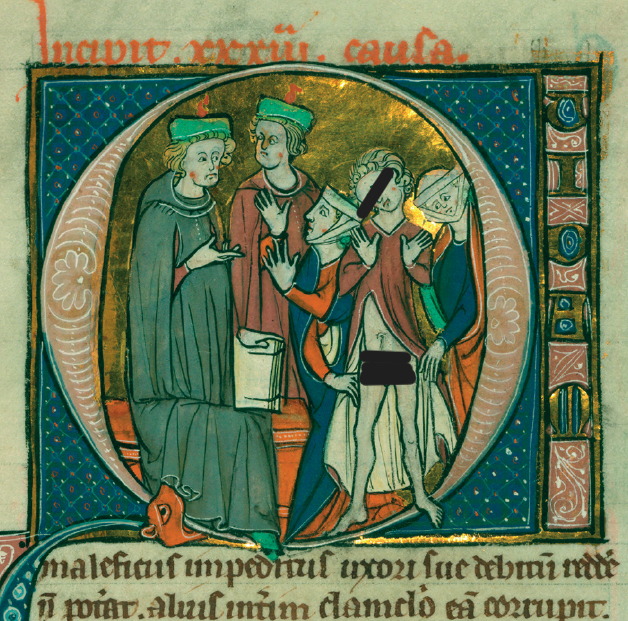
Privacy & honour of the man has been protected by me.
A wonderful insight into how women were represented in certain parts of life, like here in the arts:
“The production and sale of art was also controlled by guilds, and women were members of those relating to art. Women accounted for one in four of those listed as members of the Bruges booksellers’, printers’ and miniaturists’ guild. Likewise, women were active partners in the leading families of Antwerp printers. There is evidence of women painters as early as the fourteenth century. The Saint Luke Guild in Antwerp was composed of sculptors, tapestry makers, and painters whose work was on sale in a building near the Church of Our Lady (on present-day Place Verte). In AD 1551, Elisabeth Borremans bought eight paintings there that she transported by boat from Antwerp to Middelburg. In exchange for payment, the widows of master craftsmen produced art, thus continuing the tasks they had carried out in the workshop as wives. In this sector there were also women who were independent traders in art objects. In AD 1502, Heilwijch Swandeleere, as a “merchant”, paid the sculptor Jan Baruzeel for a reredos. Her husband (the painter Jan de Pape) was to finish the work, though Heilwijch was clearly responsible for the sale. As was the case in the production chain for many types of goods, women thus played a crucial role in running the family business. Even if works of art were often signed by men, that did not mean that they were not produced by a woman.”
A quarter of printers & miniaturists were women!
We all know about young boys and men being apprentices far from home but women and girls were doing the same;
“Outside the world of guilds, girls sometimes joined a family as a maid, or else worked under a master or mistress to learn a trade.”
This too allowed women more independence and gave them more time to prepare for a marriage and starting a family or perhaps avoid both altogether.
And something that would shock men for generations to come:
“For example, women working on large building projects in Antwerp were paid to finish polished stone. They earned the same amount as their male colleagues for this task, which amounted to a little over half the salary of an assistant mason.”
Yes you read that correctly, they earned the same as their male colleagues!
I guess glass being expensive meant that they couldn’t afford a glass ceiling… badoom-tish!
I can’t get enough of reading about foreigners being shocked about Dutch & Flemish women;
“After a visit to the southern Low Countries between AD 1577 and AD 1592, the Spanish captain Alonso Vasquez wrote as follows about the women in Brabant towns:
The women act like men. In most transactions concluded by their husbands, the couple speak with a single voice. Not only do women partake in trade and running their business, their house, and their family, but they also work as barbers in barbers’ shops. Their help with shaving is so clean, precise, and controlled that one would willingly believe they had been invented for the trade, especially as their husbands are generally in the taverns, and they thus solve their own problems with more patience and tact than their spouses.”
And here we deal with another old myth about medieval bathhouses;
“A stove was not necessarily a brothel, for there were family stoves, and others purely for men and women. In AD 1471, the Mechelen town council decided that men and women were henceforth to be strictly separated in advance, with a sign above the door informing clients which of the two sexes was welcome. Wives were however allowed to accompany their husbands in “male baths”. Yet one category of establishment for men also employed women who, for a supplemental charge, provided services to visitors in bed or in the bath. In such houses, prostitution was wholly legal, even if husbands and churchmen were not meant to share a bed with “stove maids” (stoefmaerten). Under Antwerp legislation, any married individuals discovered there were to be fined.”
More evidence of minors being protected;
“Forcing one’s own daughters to sell their body was the most serious offence in sex work. Under fifteenth-century rules in Antwerp, all the goods belonging to an inhabitant “who prostituted his daughter” were to be confiscated, and the culprit exiled for life, to which was subsequently added a whipping. A legal document dating from April AD 1491 shows that this legislation was invoked on occasion. The town had it announced far and wide that it had learned of a case in which a procurer or procuress had offered a man the services of a ten-year-old girl, an act which it described as “unchristian, impious, and unnatural”.”
And yet people think that child marriage and consummation of this marriage was common and accepted.
Imagine that, forcing children into prostitution being punished by flogging and banishment, certain countries today should think about the punishments they hand out.
So, anyway, I love this book, couldn’t put it down, I even bought the English version and a digital version so I could use it better for research purposes.
Much of what I already knew was backed up and reinforced but there were also quite a few things I didn’t know and loved learning about.
Above all I really enjoyed reading all those little stories of real people with real people problems.
The book does what I think is the best thing about good history books: it brings the past closer to us, makes it more familiar.
But it also destroys so many myths & misconceptions that most of us still have about the middle ages.
Simply by showing us what has been ignored for so long: the day to day records of the common people.

