
A lot of people still believe that in medieval Europe everyone got married at a very young age, that child marriages were very common.
This is not the case.
Please note: this article is a work in progress, as I learn more, I may add, change & replace parts.
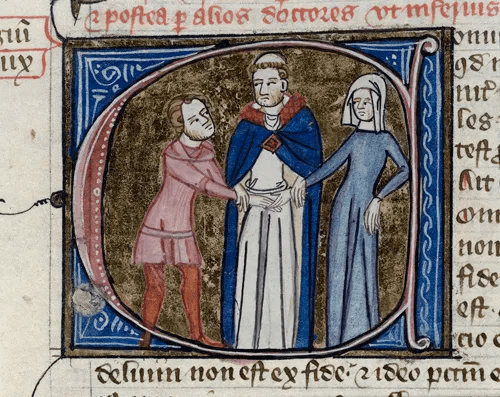
In reality most people in much of Europe during the middle ages married in their 20s.
Sometimes earlier, sometimes later, but getting married in your early teens or even younger was very rare.
Yes, nobles/royals did it, but mostly for political or inheritance reasons.
And even in those cases they often waited for years to consummate the marriage.
Ideas about when girls/women were too young for child-birth go back quite a long time in Europe.
Greek & Roman writers like Hippocrates (c. 460 – c. 370 BC), Aulus Cornelius Celsus (c. 25 BC – c. AD 50), Soranus of Ephesus (c. 98– AD 138) and Galen (129 – c. AD 216) recognised that a narrow pelvis makes births riskier for both mother and child and Soranus wrote, ‘one must judge the majority from the ages of 15 to 40 to be fit for conception‘.
Other sources, like Julius Caesar mention that among Germans the idea of having sex before your 20th was considered shameful: “to have had knowledge of a woman before the twentieth year they reckon among the most disgraceful acts” (Source: Gallic War).
In ‘Germania’, Roman historian Publius Cornelius Tacitus around AD 98, wrote:
“Slow and late do the young men come to the use of women, and thus very long preserve the vigour of youth. Neither are the virgins hastened to wed. They must both have the same sprightly youth, the like stature, and marry when equal and able-bodied. Thus the robustness of the parents is inherited by the children”.
This suggests that in parts of Europe people have known that young marriage were unadvisable and that marrying young was not the habit since prehistoric times.
Medieval texts also write about both young and old age being unsuitable for giving birth, so people knew, they were worried about birth being dangerous and wanted to protect girls, rightly so.
Let’s look at the few child marriages we can find in Medieval European history and compare the ages with how old the mother was when the first child was born.
These names are often shared by people who want to suggest that child marriage was common but as you can see this list consists of only nobles, who were of course a tiny minority at the time.
Just looking at when these women got married also ignores the fact that husbands often waited to consummate the marriage, that’s why it’s important to also look at how old these women were when they actually had their first baby:
- Constance of France (1078 – 1125)
Married at approx. 15–17; first recorded child born at approx. 30. - Cecile of France (1097 – 1145)
Married at approx. 9; first recorded child born at approx. 22. - Empress Matilda (1102 – 1167)
Married at 8; first recorded child born at 31. - Theodora Komnene, Queen of Jerusalem (c. 1145 – 1182)
Married at 13; first recorded child at 23 or 24 - Isabella of Hainault (1170 – 1190)
Married at 10; first recorded child born at 17. - Agnes of France (empress) (1171 – 1220/after 1240)
Married at 9-10, no recorded children. - St Elizabeth of Portugal (1271 – 1336)
Married at 11–12; first recorded child born at 19. - Isabella of France (1295 – 1358)
Married at 12; first recorded child born at 17. - Bianca of Savoy (1337 – 1387)
Married at 13; first recorded child born at 14. - Isabella of Valois (1389 – 1409)
Married at 6; first recorded child born at 19 (second marriage). - Lady Margaret Beaufort (1443 – 1509)
Married at 6-7; first recorded child born at 13. - Beatrice d’Este (1475 – 1497)
Married at 15, first recorded child born at 17. - Lucrezia Borgia (1480 – 1519)
Married at 13 (first marriage annulled, not consummated); first recorded child born at 19 (second marriage).
We have to of course keep in mind that we don’t know when these marriages were actually consummated but we know that it was very common for noble/royal couples to wait for both parties to be “of age” and these numbers support that even though there could have been cases of fertility issues or other problems.
It is still quite telling that although child marriages were common among the extremely small number of nobles/royals, children giving birth was very rare.
In a time when anti-conception was not that commonly used (it did exist though), techniques to avoid pregnancies were far from foolproof and procreation was one of the biggest reasons for marriage and a way to solidify the union, the age when a woman first gave birth is a relatively reasonable indication of when she first started having sex.
Also interesting is that there’s quite a bit of evidence of people being concerned about the young age of some of these women, commenting on it and even being critical, like in the case of Lady Margaret Beaufort who got pregnant when she was 12 and gave birth at age 13.
People disapproved of it.
That she herself considered it something that wasn’t right is proven by her objecting to her own granddaughter being married at 13.
I quote from: ‘Blood sisters, the hidden lives of the women behind the wars of the roses’, by Sarah Gristwood:
The labour was long and difficult. Both Margaret and the child were expected to die, and were there to be a choice some Church authorities urged that those in attendance should prioritise the unbaptised baby, even it were not a valuable boy. There seems little doubt that her physical immaturity was part of the problem – as her confessor John Fisher would later put it: ‘It seemed a miracle that of so little a personage anyone should have been born at all.’ She herself thought so, at least: in later years she would combine forces with her daughter-in-law Elizabeth of York to ensure that her young granddaughter and namesake Margaret was not sent to Scotland too early lest her new husband, the king of Scotland, would not wait to consummate the marriage ‘but injure her, and endanger her health’.
There seems little doubt that Margaret Beaufort was indelibly marked by her early experiences – perhaps physically, since neither of her two subsequent marriages produced any children, and certainly mentally.
Contemporaries remarked on her sense of vulnerability.
More about this in ‘The English Works of John Fisher‘, ‘Margaret Beaufort: Mother of the Tudor Dynasty’, ‘The Paston Letters’ & ‘The King’s Mother: Lady Margaret Beaufort, Countess of Richmond and Derby‘.
We can also find these ideas confirmed by medieval laws.
In England the law made a mention of ‘infra aetatem’, this meant within age and for girls this meant 12 years and older.
In relation to laws about rape this meant that having sex with a girl under the age of 12 was automatically considered rape, regardless of if she consented.
In the 1275 Statute of Westminster (Statute of Westminster I it says “AND the King prohibiteth that none do ravish, nor take away by Force, any Maiden within Age (neither by her own Consent, nor without) nor any Wife or Maiden of full Age, nor any other Woman against her Will.”
This law is probably much older than this statute.
Rape being a punishable offence was also quite common in much of Medieval Europe, women and girls were protected in many ways.
And, again, although child marriages did happen among the noble/royal class of Europe, even among this tiny minority of the population it was also not as common as is sometimes suggested.
For them too it was more common to marry in your late teens or after.
It is even a massive stretch to suggest that child marriage was a widespread practice among the elite.
Among common people children getting married was practically unheard of, even marrying at a young age was very uncommon.
There are several reasons for this that were almost unique to Europe, especially North-Western Europe:
- Both men & women inherited from their parents and had the opportunity to actually work and look after themselves.
So the need to get married young was not the same as in other parts of the world.
A woman on her own, at least in the cities, would not necessarily find it impossible to survive. - When you got married you were expected to move out of your parent’s home and find your own place, for this you needed quite a bit of money.
This money didn’t (all) come from the parents, dowries were rarely enough to buy a house and in most cases the dowry would be things, not money.
It could also take years for the dowry to be big enough to start a household, even without having the actual house. - On top of that both man and woman had careers.
With that I mean that they could both be apprentices, learning a trade or worked in someone else’s household as a help.
This could take years and it was often very difficult to cancel such an apprenticeship, your parents could have paid dearly for your education. - The church had been pushing for marriages to be consensual, so both parties had to agree to the union, which made it a lot more difficult for parents to marry their kids off.
All this combined explains why so many medieval Europeans didn’t get married till they were into their 20s.
I will now share a whole bunch of quotes & sources that back up my claims and explain some of the details.
My conclusion follows after that.
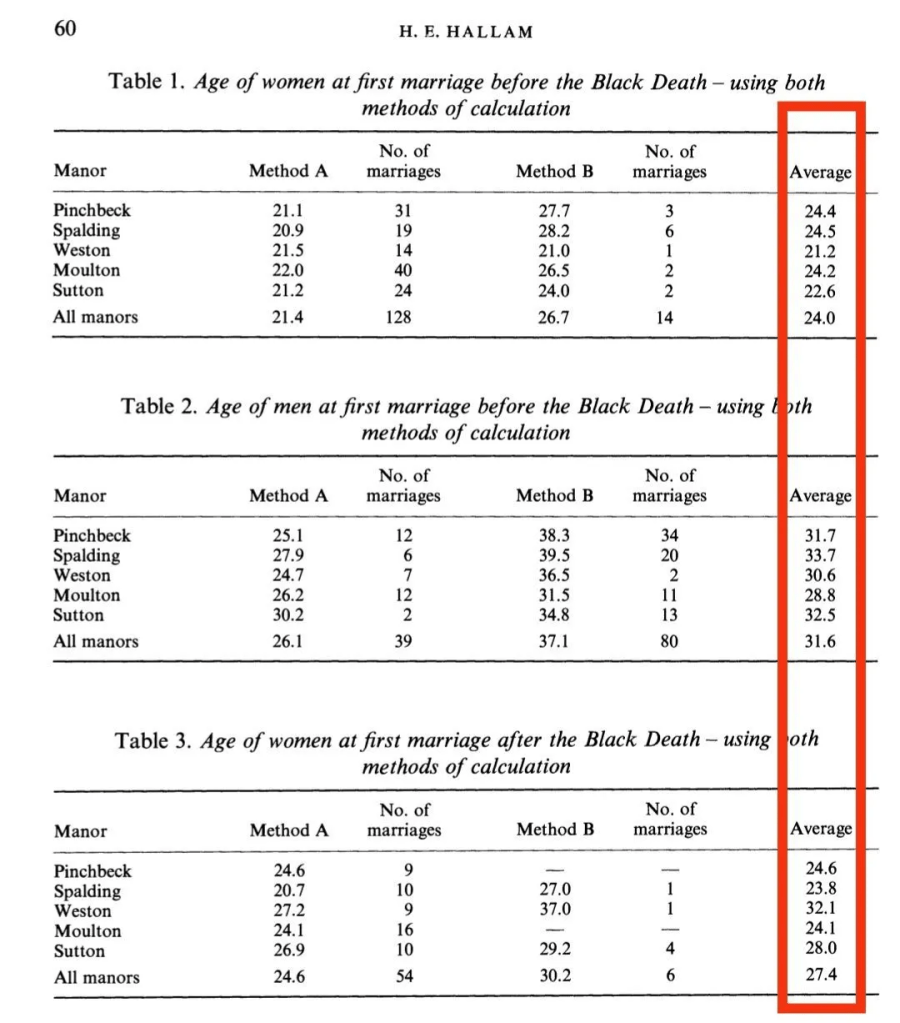
Age at first marriage and age at death in the Lincolnshire fenland, 1252-1478, by H.E. Hallam:
From The Ties that Bound: Peasant Families in Medieval England By Barbara A. Hanawalt:
In the early fourteenth century, when land was hard to come by and wages were depressed, couples married in their early twenties. With the new economic opportunities opening up following the Black Death, the marriage age for women and men dipped into the late teens.
We have been suggesting that medieval peasant youth married young, but none of our sources so far have given ages. The absence of concrete evidence places greater value on the more subtle indicators of cultural attitudes toward the age at which marriage and sexual relations were considered appropriate. We must, therefore, look at unorthodox sources to determine what the society thought was the normal age of first marriage. All evidence points to the mid-teenage years as being too young for adult responsibilities, including marriage. The poll tax itself did not tax youth of fourteen because they were not fully adult. In the prosecution of rape cases, jurors singled out as especially reprehensible those men whose victims were teenagers and were much more likely to convict such offenders. One father lost his life trying to save his teenage daughter from a rapist. She had gone to the woods to gather sticks when the rapist approached her carrying a bow and arrow. She called for help from her father, who came to her rescue but was shot. The rape and attempted-rape cases indicate a feeling on the part of society that girls in their teenage years should be sheltered from sexual encounter and that violent sexual attacks on them were repugnant.
Another legal indication that adult marriages were preferred was the continued custom of keeping the age of majority for inheritance at twenty-one and higher. Such a high inheritance age was a signal, if not always an impediment, to youth to delay marriage. While these bits of evidence from legal records are far from conclusive, they do indicate that early and middle teenage marriages, and perhaps even sexual contacts, were not the norm.
But the canon law, applicable to all Europe and not England alone, permitted a very young age for marriage contracts. Children under seven could not enter into marriage
contracts, and those over that age could repudiate the agreement at the age of puberty. For boys puberty was canonically established at age fourteen and for girls it was twelve. Few cases appeared in ecclesiastical courts arguing for dissolution of marriage or contract on the grounds of the parties being too young. The situation may seldom have arisen because children so young contracted few marriages or their repudiation was accepted without a court case.
Cultural evidence suggests that marriage of teenagers was not normal and that a young Romeo and Juliet marrying in England would have created scandal. Furthermore, the great age disparities between husband and wife found in Italy were not the norm in England. In evaluating the evidence of age at first marriage and percentage marrying, it would appear that Hajnal was correct in suggesting that in medieval England the age of marriage was lower than in the modern period and a greater proportion of the population married. But his thesis requires some modification to take into account the fact that age of marriage could vary with economic and social conditions and that it was never common to marry in the early or middle teens.
You can read my full review of this particular book here:
https://fakehistoryhunter.net/2026/01/17/book-review-the-ties-that-bound-peasant-families-in-medieval-england-by-barbara-a-hanawalt-1986/
The following texts come from the book ‘Dievenland: Overleven in de Middeleeuwen’ by Janna Coomans, but the book is in Dutch so it’s my translation:
A servant of twenty-three—that was, therefore, an age associated with youthfulness, even though he already had (almost) three children, but also with existential insecurity. In popular culture, the image still prevails that people married very young in the Middle Ages (and also died young due to low life expectancy), and that at twenty-three, one was therefore already well into an ‘adult’ phase of life. That is not entirely correct. Young noblewomen were indeed sometimes married off at a very young age. For the nobility, and certainly for monarchs, marriage politics was one of the most important instruments for accumulating more land holdings and influence. But the high nobility was the exception, not the rule. In the Low Countries, non-noble couples often did not marry until they were in their twenties. Men, in particular, were often already well into their thirties. For a large part of society, adulthood had more to do with an independent, financially self-reliant status, and not so much with hard age limits. The dividing lines between adolescence and adulthood were complex and differed significantly by social class.
Although medieval society was permeated with inequalities between men and women, partners were often roughly the same age, certainly in Northwest Europe. Moreover, most people entered into relationships of their own free will. The exceptions were the elites, since marriage politics was perhaps the most important instrument for managing family wealth and for territorial expansion.
The following text comes from ‘Marriage Customs of the World: From Henna to Honeymoons’ by George Monger:
Historically, in Europe, child spousals were not common, and occurrence was usually among the upper and ruling classes. Generally, population studies have shown that a high proportion of people married in their mid-to-late twenties. There were several reasons for this, such as the need to accumulate enough money and goods to be able to set up home (for women this could mean leaving home and going into “service”—becoming a servant—to earn enough money to accumulate goods to take into the marriage).
The following texts come from ‘Urban Women: Life, Love, and Work in the Medieval Low Countries’ by Andrea Bardyn, Chanelle Delameillieure, Jelle Haemers (2019):
“…the average age upon marriage was relatively high: ordinary men and women generally married in their late twenties. In the event of a political alliance, a marriage between children could sometimes be concluded in noble or courtly circles. The children took their vows at a young age, but the marriage itself (together with the associated “conjugal duties”) naturally only occurred once they were older. A 1445 legal text from Brussels fixed the age of marriage at 28. In other towns this age was often around 24 or 25.”
“Sexual relations with minors were subject to punishment. In AD 1483, the bailiff punished Jan van Hoeke for having lured a 12- or 13-year-old girl out of town to “satisfy his will”. But, the bailiff declared, this attempt had failed “because of the young age” of his victim. Although the girl declared she had followed Jan voluntarily, the bailiff had him thrown into prison.”
“Forcing one’s own daughters to sell their body was the most serious offence in sex work. Under fifteenth-century rules in Antwerp, all the goods belonging to an inhabitant “who prostituted his daughter” were to be confiscated, and the culprit exiled for life, to which was subsequently added a whipping. A legal document dating from April AD 1491 shows that this legislation was invoked on occasion. The town had it announced far and wide that it had learned of a case in which a procurer or procuress had offered a man the services of a ten-year-old girl, an act which it described as “unchristian, impious, and unnatural”.”
You can read my review of this book here:
https://fakehistoryhunter.net/2025/08/04/book-review-urban-women-life-love-and-work-in-the-medieval-low-countries-by-andrea-bardyn-chanelle-delameillieure-jelle-haemers/
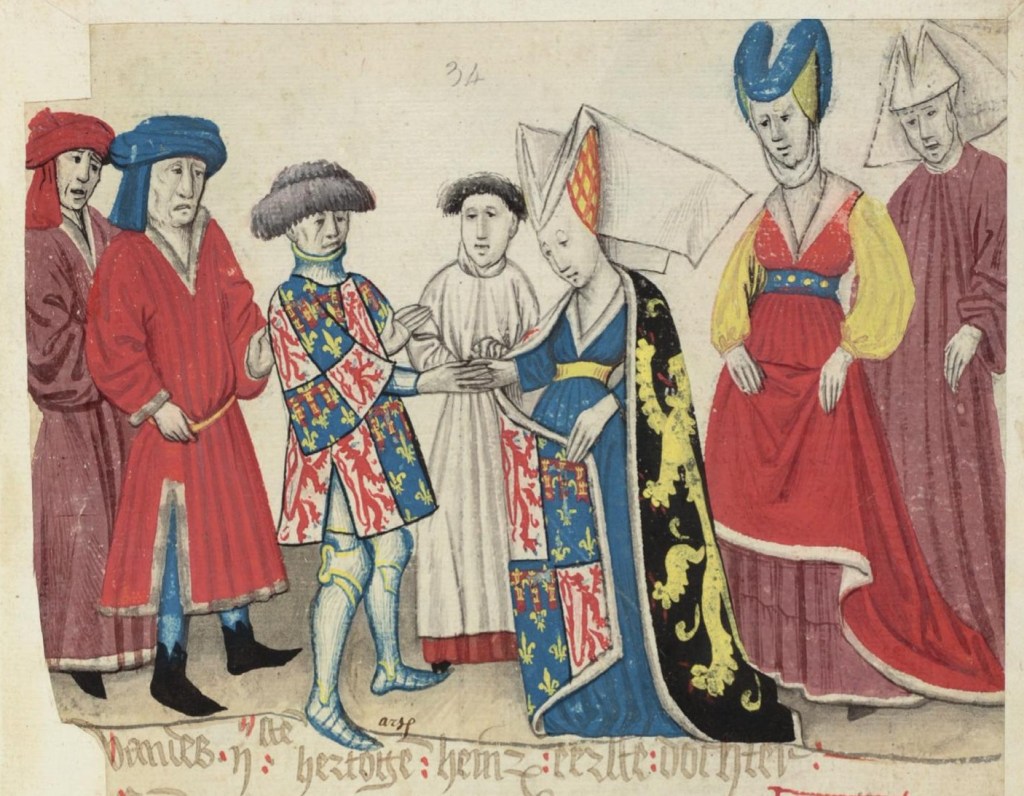
Brabantsche yeesten”-manuscripts IV 684 and IV 685, IV 684, fol. 21r., 15th c.
The following texts come from ‘Married Life in the Middle Ages, 900–1300’ by Elisabeth van Houts (2019):
We have to distinguish between the age of consent and the age of physical maturity or puberty. The two were often different as not all girls and boys would reach sexual maturity by the ages given above. Conception could not take place if the girl had not started menstruation. According to the Trotula, a medical treatise on female health written in twelfth-century southern Italy and well known in northern Europe, the age at menstruation was around thirteen, but could be a little earlier or later. Modern medical opinion on the onset of menstruation in medieval women sees thirteen or fourteen as realistic. The difference between the age of reason and the age of physical maturity was well understood and was taken into consideration by lawyers and medical doctors as well as by the children’s parents. Under canon law, marriage with a spouse below the age of puberty and below the age of reason was imperfect, even though in the later Middle Ages papal dispensation could be given to the former.
Her widowed mother Countess Marie de Grandpré handed her over, having received confirmation of the betrothal and assurances from the Joinvilles that Alix would be protected. They married in 1240 when Jean was fifteen and Alix at least thirteen. There is no sign of consummation then and children did not arrive until 1247 and 1248. It is interesting, though not surprising, that Alix’s mother asked for assurances for her daughter’s safety (read: virginity) in case the marriage should fail and that Alix be returned intact.
As for the age at which people got married in the central Middle Ages there is a
strong consensus amongst medieval historians that we must distinguish between
north-western Europe (England, France north of the Loire, the Low Countries,
and Germany) and the rest of Europe, except for royal women, who tended to be
the youngest brides, in their early to mid-teens. The influential work by Hajnal
established that in the north most couples were very similar in age when they firs
married, in their mid- to late teens, with disparity in age an exception and not the
rule, at least in medieval France.
As for the lower social strata, there is some similarity for urban girls, as Italian and English girls tied the knot in their mid-twenties, an age profile that was later than that of peasant girls who married in their early twenties. Men at marriage, in northern Europe, as said, were normally a few years older than their wives, though at the highest social level kings and princes could be considerably older. For England in towns and countryside the age difference between men and women was usually only two or three years. In southern Europe the best evidence comes from Renaissance Italy, where men of all social classes were usually much older than their wives, as much as a decade if not more.
The following text comes from ‘A Cultural History of Marriage in the Medieval Age’, edited by Joanne M. Ferraro (AD 2021):
In regions of northwestern Europe where marriage tended to be relatively late (in their twenties) for both men and women below the level of the elite, and where a period of service outside of the natal family often preceded it, it is not surprising that couples would have made more of their own marital choices than when they were married off by their families in their teens, and that they would and likely did make those choices based in part on passionate love—or that at least one of the partners thought it was love
The following texts come from ‘Population in history. Essays in historical demography.’, edited by D. V. Glass and D. E. C. Eversley, specifically the chapter ‘European Marriage Patterns in Perspective’ by John Hajnal:
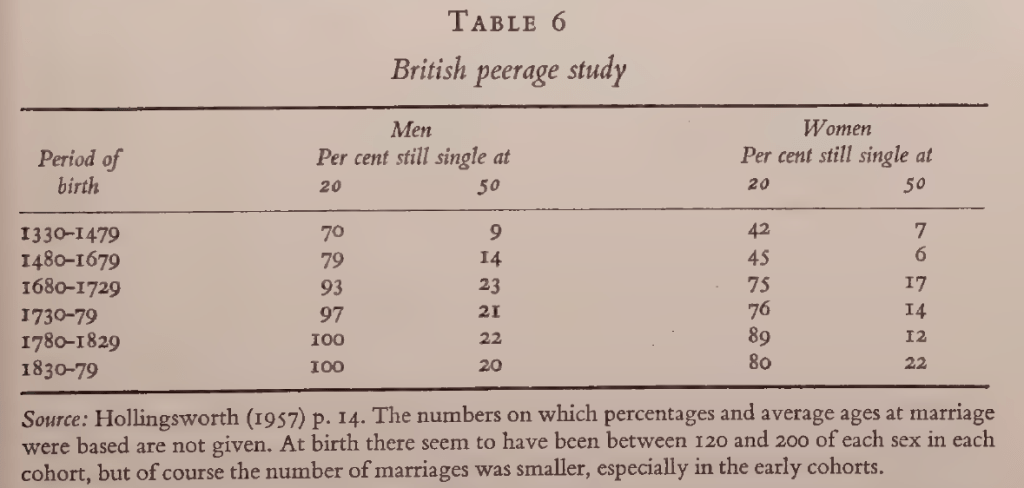

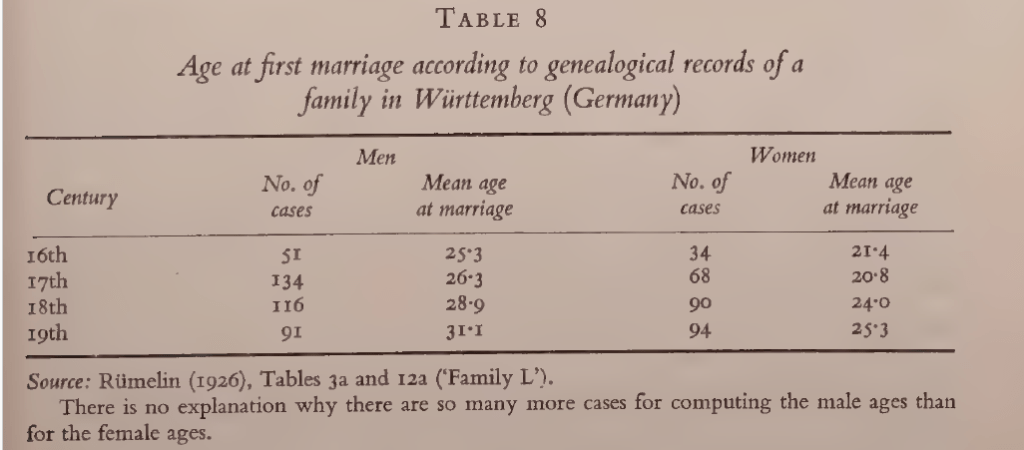
The following texts come from ‘Girl Power: The European Marriage pattern and Labour Markets in the North Sea Region in the Late Medieval and Early Modern Period’ by Tine De Moor and Jan Luiten Van Zanden:
The EMP emerged in north-western Europe because of a combination of three
socio-economic and ideological factors: first, the stress on consensus instead of
parental authority for the formation of a marriage; second, the position of women
in the transfer of property between husband and wife and between parents and
children; and third, the accessibility to, and size of, the labour market.
The fact that both the man’s and his future wife’s consent was necessary for
marriage meant that it was a contract between ‘equals’ since neither one could
impose consensus upon the other partner. This means that in principle the bar
gaining position of women in such a marriage pattern is relatively strong: a woman
could (try to) select the kind of husband that suited her.
One of the factors that can contribute to our understanding of the emergence of the EMP in north-west Europe, and not in the south, is the difference in the system of property inheritance between generations and between husband and wife in these two regions. The western inheritance system was distinctive because of women’s rights to inherit, and the ability to transfer landed property to and through women, as inheritants or as dowers. Within Europe, both the bride’s and groom’s side of the marriage had property rights in their union.
Marriage played a crucial role: the bulk of the daughter’s share of the inheritance was either transferred to her at the start of her marriage, in the form of a dowry, or at her parents’ death. The former was more typical in the south of Europe and the latter was common in the north, although pre-mortem endowments and dowries were not unusual in the north either. Essentially, intergenerational property transfer was less closely related to the event of marriage in the north than in the south.
The property that a bride brought into the marriage was not held separately as it was in the south, but was instead merged into a communal account that was under the full control of the husband but to which the widow also had rights.
To a certain extent we can only speculate about the potential effects of differences in property transfer regimes on marriage and on household formation. First, we claim that there was probably a direct relationship between marriage age and property transfer between parents and children, which influenced the parents’ decision to marry off their daughters as soon as possible, while also affecting the wives’ degree of control over when their marriage would take place. If a woman had a right to her parent’s inheritance without having to marry, there was no financial incentive for an early marriage.
In a dowry system, women had incentives to marry early. It probably created similar incentives for parents. In fifteenth-century Tuscany, the larger the contribution of the bride to the marital household (in terms of ability to perform household work and to bear children), the smaller the dowry her parents would be obliged to pay to ‘convince’ the groom to accept their daughter. A woman who waited too long before marrying would become too expensive to ‘sell’ in the marriage market. Her parents would have to pay a larger dowry to compensate the groom’s household for the smaller net positive contribution the bride would provide in the marital household. The younger the bride, the larger her net positive contribution to the marital household and, therefore, the smaller the dowry her parents had to pay. The importance of the age of the bride is also evident from the fact that—as Molho has shown—many fathers presented their daughters as being younger than they actually were in the Catasto, in order to improve their marriage chances.
In the north, the preaching of the Church and inheritance patterns may have made it easier for young men and women to defy parental authority, decide whom they wished to marry, and set up an independent household. But it was the rise of labour markets in Europe at the time that was most fundamental to the consolidation of western European marriage habits into a recognizable pattern. Before AD 1348, a well-developed labour market had emerged in many parts of western Europe, in which a significant share of the population earned a living. After AD 1348, the sudden fall in population levels due to the Black Death led to a booming labour market with a growing demand for labour—of both men and women—resulting in a strong increase in real earnings, in particular for women.
Goldberg calculated that Yorkshire female servants entered servanthood in their early teens and often worked until their mid-twenties—after which they married—whereas female servants in Florence and Barcelona started work at the age of eight and left service before they turned 20.
A number of authors (including Beveridge and Hilton) have noted the strong increase in nominal and real wages of women after AD 1348, also pointing out that in some cases women were paid the same as men for the same kind of work. Hilton noted also that ‘around AD 1400, countrywomen were doing the same manual jobs as men, such as haymaking, weeding, mowing, carrying corn, driving plough oxen, and breaking stones for road mending’. There is evidence for a similar absence of a gender gap in Holland from the mid-fourteenth until the mid-sixteenth century.
In the 1580s and 1590s, the mean age at first marriage for women in Amsterdam fluctuated (according to unpublished research by Hubert Nusteling) between 23.5 and 25 years, and it remained at this level until the 1660s, when it started to rise even further.
The European behavioural patterns were based on a large degree of mutual trust: teenagers from the age of 10 onwards (and sometimes even younger) were entrusted to the households of other individuals, the search process for a future spouse was entrusted to young adolescents, and women (and men) could actively engage in wage labour and in the social interaction that accompanied it, often in places distant from their homes, without damaging their reputation. Perhaps the best examples of these high levels of mutual trust are the practices of courting and of pre-marital sex that emerged.
Couples hardly denied themselves all sexual activity. The important thing was to avoid having babies, and evidence on courting practices throughout north-western Europe reveals that couples, especially those already betrothed, often engaged in socially sanctioned sessions of petting and fondling’. Kok, in a similar analysis of these practices in the Netherlands, also pointed out that it was based on a remarkable degree of trust in the young people, who were allowed to enjoy these ‘games’—a degree of trust that in most cases was justified, as levels of illegitimacy were lower than elsewhere.
In the sixteenth century, a majority of the male population of Holland could read and write, and these skills were evident in both towns and in the countryside (as the famous Italian traveller Guicciardini testified in the 1560s). In AD 1585, about 55 per cent of grooms and 32 per cent of brides could sign their name in the marriage registers of Amsterdam.
Conclusion:
As all these texts and the historical sources & records show, Europeans, at least in the North West, did not marry young, except a tiny percentage of nobles & royals.
This had a huge effect on progress in this region, very likely playing a role in why Western Europe became such a powerful entity in the following centuries.
People marrying later and both men & women having to earn a living before that time meant much more workers were available for the labour market, this would boost the economy.
This European marriage pattern lasted for many centuries, marrying later than elsewhere in the world still took place during the industrial revolution, the time of European colonisation of other continents, empire building, etc.
With men & women marrying later it gave men but especially women opportunities unheard in much of the world then, but sadly even still today.
It was more common for women in NW-Europe to have an education, learn to read and write, have a job, gain independence and it increased their chances of marrying someone they actually liked or even loved.
They experienced levels of freedom & equality that for billions of other women remained impossible for centuries to come and in some countries is barely imaginable at this moment.
This all had a huge effect on the lives of countless people and would have a direct impact on global history.
Finally a few words on biology.
I am not a biologist, far from it, but I can’t resist adding a few interesting facts & figures about the human body, marriage & having babies.
But if you’re a doctor, biologist, scientist, etc. and know better, please don’t hesitate to correct the following.
Nature seems to give us a few clues on when the best age is to get married and have babies.
Both of these moments in life involve making some very big important choices, so you should make them when your brain is at its best premium state to make life changing decisions.
Part of our brain, especially the frontal lobe, continues to mature long after puberty starts & ends.
We use this part to make important decisions, but it’s also important for impulse control and regulating your emotions.
I’m not saying your brain is all done growing up when you reach your 20s, but it does seem that you’re better at those things I just mentioned than when you’re a teenager.
So when it comes to your mental state, nature is giving us a pretty big clue about that it’s best to wait making such big decisions till you’re in your 20s.
If you’ve ever been near teenagers or have been one yourself, you know that’s true.
But physically we also get a few clues.
For instance the female pelvis widens to prepare for childbirth, this begins during puberty but continues for years, reaching adult pelvic dimensions when women are in their late teens, early twenties.
Other parts of the body are often also still maturing when you’re in your teens and any part of the body that’s not done growing yet can have an impact on the pregnancy.
If the mother isn’t fully grown yet, her body might compete for much needed nutrients with the foetus, this could result in low birth weight babies.
All this can result in higher risk of preeclampsia, anemia, developmental delays, long term health issues and prolonged labour, adding risks to an already dangerous and potentially lethal situation.
Maternal and infant mortality was very high during the middle ages.
Medieval people knew all this and were very aware of growing up having different phases and that the beginning or end of puberty was not the beginning of adulthood.
Many texts, going back almost 2000 years, made it clear that having babies when you weren’t fully developed yet was unwise and dangerous.
Soranus of Ephesus wrote in the 2nd century AD in his text ‘Gynaecology‘ that conception is safest only after the body is fully developed and that too early pregnancy damages both mother and child, he even already mentioned that the pelvis has to be fully developed, his texts were used by medieval physicians.
This knowledge became common standard in Hippocratic, Gelenic & Medieval Latin medicine.
The most well known medieval gynaecological work ‘Trotula’ also repeats that if a woman’s body isn’t properly developed childbirth can be dangerous.
In the 12th century Hildegard von Bingen wrote in her Causae et Curae that having babies while the mother is not yet fully mature could result in babies with a weaker constitution.
So both mentally & physically your 20s are the safest time for having babies.
This of course doesn’t mean that teenagers can’t give birth safely and turn out to be happy, healthy mothers to healthy babies.
But it is still riskier and more dangerous.
Puberty is the beginning of your body sexually developing, but this is a phase, not an instant moment, it can take years for these changes to finish.
Humans can have babies early on because it seems like nature did a complicated bit of maths and realised that if humans are having a really bad time and keep dying, the odds of the species surviving are higher when you just make babies asap and as often as possible, putting having babies above the survival of the mother.
Waiting till you’re in your 20s when you may not even live that long just doesn’t always work.
This biological system is millions of years old, set up at a time when we were barely surviving.
This was no longer the case during the middle ages.
Luckily back then a lot of people cared about the health of the mother as well as that of the baby.
Anyway, it’s very interesting to me that so much is pointing towards your 20s being the most fitting age for marriage & babies and this being the situation in Medieval NW-Europe.
This too may have had a big effect on the health & survival chances of women in that region.
In the Netherlands the situation was even more advanced during the middle ages.
Women had access to education, some had families without being married, could get separated, were protected from abusive husbands, had equal inheritance, etc.
More about that here;
References, sources & links:
- The Ties that Bound: Peasant Families in Medieval England By Barbara A. Hanawalt
- ‘Blood sisters, the hidden lives of the women behind the wars of the roses’, by Sarah Gristwood
- ‘Dievenland: Overleven in de Middeleeuwen’ by Janna Coomans
- ‘Urban Women: Life, Love, and Work in the Medieval Low Countries’ by Andrea Bardyn, Chanelle Delameillieure, Jelle Haemers (2019)
- ‘Married Life in the Middle Ages, 900–1300’ by Elisabeth van Houts (2019)
- ‘The English Works of John Fisher‘
- ‘A Cultural History of Marriage in the Medieval Age’, edited by Joanne M. Ferraro (AD 2021)
- ‘Population in history. Essays in historical demography.’, edited by D. V. Glass and D. E. C. Eversley
- ‘Margaret Beaufort: Mother of the Tudor Dynasty’
- ‘The Paston Letters’
- ‘The King’s Mother: Lady Margaret Beaufort, Countess of Richmond and Derby‘.
- https://www.medievalists.net/tag/marriage/
- ‘Girl Power: The European Marriage pattern and Labour Markets in the North Sea Region in the Late Medieval and Early Modern Period’ by Tine De Moor and Jan Luiten Van Zanden
- The Evolution of the Age at Menarche from Prehistorical to Modern Times
- 1275 Statute of Westminster (Statute of Westminster I
- ‘Marriage Customs of the World: From Henna to Honeymoons’ by George Monger
- https://en.wikipedia.org/wiki/Western_European_marriage_pattern#Middle_Ages
- https://www.reddit.com/r/AskHistorians/comments/3pafst/what_was_the_average_marriage_age_for_people/


One thought on “Age of marriage & giving birth in medieval Europe”