
This may sound like a boring book but for me, a historian obsessed with debunking the old myth that medieval people were dirty, rarely bathed, etc. it’s quite a fascinating read and I think it has plenty of interesting details in it that most people will find interesting.
So as I read the book I marked fascinating parts, I’ll just share the best here in this review.

Medieval hygiene and, well, generally a more serious look at what medieval life was really like for the common man, has only been given the proper attention it deserves in the last couple of decades, before then historians often just copied what historians had said before them, repeating Victorian opinions.
Luckily this has changed and recently a couple of books have come out that have actually researched original medieval records and shown us a whole different perspective.
But most of these are about the high & late middle ages.
The early middle ages is still a bit neglected when it comes to this topic and the idea that after the Romans Europe pretty much collapsed and returned to an almost prehistoric way of life is unfortunately still quite common even though historians have been trying to explain to people that and why we no longer call that era the “dark ages”.
But what about the water technology like aqueducts, bathhouses, etc. what happened to that when the Romans finally went home?
Romani ite domum!
A topic that’s doesn’t seem to have been given a lot of attention by historians, so I was very happy to see Magnusson start the book with it:
“The political, religious, and social upheavals of late antiquity and the early Middle Ages produced fundamental changes in social organization and cultural values, which triggered contingent changes in the social components of hydraulic systems. Many ancient systems collapsed altogether and were discarded; others underwent radical restructuring, as old physical components were reemployed to meet new goals.
The early medieval evidence presents a patchwork of continuity and discontinuity, discard and renewal. The old assumption that Roman aqueducts were either destroyed by barbarian invaders or robbed for their lead in late antiquity is being replaced by a more nuanced picture of local and regional differentiation. A growing body of evidence demonstrates that in the centuries following the so-called fall of Rome, at least some ancient aqueducts were restored or remained in use. In the city of Rome itself, popes Hadrian I (772–95), Paschal I (817–24), Gregory IV (827–44), Sergius II (844–47), and Nicholas I (858–67) undertook repairs to four of the classical aqueducts (the Aqua Virgo, the Traiana, the Claudia, and the Iovia). A Roman aqueduct at Brescia was reutilized from 761 onward to supply the convent of San Salvatore. Some Roman drains and fountains may also have continued to function. Saint Cuthbert saw what may have been a working Roman fountain on his visit to Carlisle in 685.
The monumental Roman sewers in Pavia, familiar to Liutprand of Cremona in the tenth century, were still familiar to Opicino de Canistris in the fourteenth and appear to have flowed continuously throughout the Middle Ages.”
“In Britain, most Roman water systems do not seem to have outlasted the Roman occupation, but in northern France it has been estimated that about half of the Roman aqueducts were still functioning in the Merovingian period.”
I find this fascinating, it changes the image a lot of us (still) have, yes, there was neglect & destruction, but also continuity, restoration & eventually replacement by new, sometimes better systems, like underground pipes & conduits in stead of aqueducts open to the elements.
I sometimes feel that when people talk about the early middle ages, the chaos and “decline of civilisation”, they’re only looking at England or even just London, where things admittedly were a tat dire for a while.
But that situation was not representative for the rest of Europe and this seems to support that idea a bit.
“The monk Notker designed a complicated new water system for Lobbes in 974. Louis II granted the bishop of Verona permission to take a water pipe across a public bridge in 873 and gave the monastery of San Sisto at Piacenza permission to restore the ancient aqueducts or build new ones in 874. The monastic complex at Saint Gall, Switzerland, seems to have had some sort of water system (perhaps wooden pipes?) in 890. The “aqueduct which runs below the dormitory” at Abingdon Abbey, built by Aethelwold (954–63), though, was probably a simple channel.”
Just a couple of examples of medieval people doing impressive things with water in what some still call the “dark ages”:
“At the local level, the successful adoption of a water system by one subgroup could lead to secondary diffusion across social boundaries. Though most cities had no complex systems at all, those that did have them often ended up with several monastic conduits, multiple municipal conduits, and networks of branch lines to other institutions, such as hospitals and churches. In Bristol the hospitals of Saint Mark, Saint John, and possibly also Saint Bartholomew were probably fed by pipes from the Greyfriars’ supply. The London Charterhouse springs also fed a pipeline to the nuns at Saint Mary Clerkenwell. In Smithfield the hospital of Saint Bartholomew leased a supply of piped water from the nearby priory.
Religious houses functioned as vital communication channels in the diffusion of technological awareness to medieval townsmen. In many cities the first water systems belonged to an urban friary or cathedral chapter. These served as technological exemplars and in some cases became the actual nuclei of civic systems. The Christ Church, Canterbury, waterworks plan portrays a fountain outside the main precinct, which would have been accessible to the general public.”
“The initial construction of the Great Conduit in the mid-thirteenth century may well have been a response to the city’s rapid demographic growth, but the expansion of the system in the late fourteenth and fifteenth centuries occurred during a period of prolonged demographic decline. Cities that adopted complex systems did not fit a single demographic profile: a few, such as London and Siena, were very large by medieval standards. Others, such as Bristol, were moderate-sized cities, and some, such as Exeter, were modest provincial towns.”
Complex water systems in Medieval Europe often started at monasteries, they needed running water for their toilets, cooking, cleaning, industry, etc.
And I guess God has a lot of money, so they could afford it before others could.
But as the book explains, it wouldn’t be long till neighbours started asking if they too could perhaps connect a few pipes to the system the monks were using.
And before you know it there were fountains and private channels everywhere and locals got a little aggressive when you wanted to cut them off…
“Medieval Europeans seem to have been aware that ingesting polluted water could result in illness, even if they lacked a scientific theory of waterborne pathogens. In 1374 Katherine Bishop of Norwich accused Ralph Crete of causing her water supply to become polluted with dung and filth; she claimed that as a consequence of tasting the water and using it in the preparation of food, she and her servants had become so ill that their lives were threatened. Joan Boys of Bamburgh was “poisoned” and prematurely delivered a stillborn child as a result of drinking water from a well that contained the body of a dead dog. Pollution of the bottino was believed to be responsible for an outbreak of illness among those drinking water from the Campo fountain in Siena. Odors emanating from polluted water were also thought to cause disease: in 1290 the White Friars of London complained to the king that the putrid exhalations from the Fleet were so powerful that they were rising above the scent of incense burnt upon the altar and had caused the deaths of many of the brethren… Contaminated or poisoned water was a suspect during plague outbreaks, although in this case the correlation between disease and water pollution was false. The London conduit accounts for 1348–50 include the cost of examining the conduit “when it was slandered for poison,” a charge almost certainly associated with the outbreak of Black Death, which arrived in London late in 1348. The dates of London’s fourteenth-century sanitation ordinances, which include strictures against polluting the Thames, coincide with the recurring outbreaks of the pestilence in the city. The terrible accusations leveled against Jews or lepers of poisoning wells, particularly prevalent during plague outbreaks, again point to a perceived linkage between water quality and the transmission of disease.”
This is a very important bit as it so clearly destroys the idea that some people still have involving medieval people just drinking dirty water all day and not caring about it being filthy.
Of course it’s nonsense, think about it.
If you drink bad water you’re going to find out that this was not a good idea REAL FAST.
That’s a lesson you only need to learn once.
In reality medieval people got very upset when someone polluted their water, they knew this would make you sick and could kill you.
Remember, they believed in the Miasma theory!
“Complaints about the accumulation of refuse on the Thames frontage precipitated ordinances calling for the use of dung-boats: these did not eliminate fluvial pollution, but they mitigated it by conveying the filth out to the middle of the river, where the current was strongest… The quality of river water was compromised not because medieval civic officials were insensitive to hygiene but because watercourses were irreplaceable components in sanitation systems that aimed, above all else, at keeping the streets reasonably clean. Though municipal officials continued to issue proclamations against the more egregious sources of river pollution, the problem of providing a clean water supply was tackled more successfully through the adoption of a technological solution.”
Yes, some cities/towns/villages used streams & rivers to get rid of waste, in many cases it simply was the only option.
Manually carting it out to the countryside was also done, but when you’re dealing with the waste of hundreds, even thousands of households every day, that won’t work.
But people still weren’t stupid, they made laws & rules about when you could throw filth in the river, making sure that it happened when ebb or flow would take the rubbish away to outside the city.
“The commune built and paved new roads in order to make the fountains more accessible. Nevertheless, residents of the upper parts of the city had to walk down steep streets to reach the city’s thirteenth-century fountains. The climb back up, carrying a heavy water jar or load of laundry, was arduous, and there were reports that women were being assaulted on their way to fetch water. In the mid-fourteenth century, the commune invested thousands of lire in bringing water to a new public fountain in a more central location, the Campo.”
Men, being a nuisance to women, some things never change.
In many places the carrying of water wouldn’t be as big a chore as one might think, wells were quite common, especially in central and western Europe were groundwater is relatively close to the surface.
Archaeological evidence from a German village shows several wells in people’s gardens, sometimes shared between households, as well as a couple of public ones.
I have done a little research into this but it would be great if someone wrote a paper on it, because finding out how common wells actually were in Medieval Europe would be fascinating and could also play a big role in dealing with some old myths & misconceptions.
After all if you only have to walk 3 meters into the plot behind your house for clean water to cook, clean or bathe in, in stead of having to walk 3 miles, will make it a lot more likely for people to wash themselves more often.
“In July of 1244, Henry III granted Edward, son of Odo, the right to take a private pipe the diameter of a goose quill to his court in Westminster.”
The diameter of a goose quill can be 2-6 millimeters, a bit like a drinking straw.
Which may seem like not very useful, I mean how much water would you get through that?
But if it had a bit of pressure, it would still fill your jug pretty quickly and it would be less work than lowering a bucket into a well and pulling it up again.
Still, it’s not very generous.
“In Paris, once the precedent had been established in the mid-thirteenth century, requests for private branch pipes multiplied, as the local nobility and others with friends in high places used their clout to obtain their own water pipes at the expense of the public supply.”
Typical!
“Two years later, the city made another private pipe grant, this time to William le Deveneys, the town clerk. In 1323 Master Walter de Istelep obtained the right to take a pipe the diameter of a goose quill to his house, in exchange for a rent of six pence. A few years later, Nicholas Falstolf and his wife Cecilia obtained a subsidiary branch pipe from Walter de Istelep’s cistern for the rent of one penny, for the use of their own home. The enterprising Falstolfs were also permitted to supply all of their tenements in the parish with their private pipeline.
Illicit extensions of public systems indicate that hydraulic knowledge was filtering down to a broad segment of the population and was stimulating some unregulated “private adoption decisions.” In 1478 London’s William Campion was hauled up before the mayor and the aldermen for unlawfully tapping a public conduit pipe and conveying the water to his house on Fleet Street and elsewhere.”
Again the goose quill!
But the small tube is starting to make sense, after all, if everyone suddenly wants running water in their homes, soon there won’t be any water left for the rest.
So one can’t be too generous.
But this text is telling us something most of us would never associate with the middle ages: not just running water, but running water in the houses of individuals, not just rich ones either.
Everyone seems to have been trying to nick water, all those dirty dumb medieval people who not only never washed but were literally terrified of water… ahem… were risking punishment to steal water and installed running water systems in their homes…
“Even some villagers were displaying considerable technical enterprise in the matter of illicit water diversions. Sir Reynold Hagbech brought John Snake and his fellow villagers at Emneth (Norfolk) to the king’s court on a charge of trespass in 1387. The villagers had diverted Sir Reynold’s stream and were distributing the water in turn among their dwellings through a subterranean network of lead and wood pipes—a practice that the villagers freely admitted but which they defended on the grounds that everyone in the village had done so from time immemorial.
Waste disposal also stimulated some creative private innovations. In 1314 Alice Wade was summoned before the mayor of London for running a wooden pipe from her indoor privy and connecting it to a subterranean public gutter, which passed beneath the street and the houses in Queenhithe. Wade’s clever attempt to hook up her latrine to a public drain was discovered when the filth she had been casting down her privy clogged the system so that it began backing up and fouling the houses in the neighborhood. She was given forty days to remove the pipe.”
There we go, regular villagers with top of the range, fancy pansy running water in their dwellings!
And poor old Alice, she’s been mentioned in quite a few books, imagine this being the only reason you’re remembered centuries later…
But actually, well done Alice.
A medieval woman who had an indoor toilet that was connected to a “subterranean public gutter” (I’m always a bit confused when authors seem to avoid calling sewers sewers), I mean she deserves applause as well as a warning.
“Sir Humphrey Stanley of Pipe cut off the supply effectively (if crudely) by smashing the aqueduct in 1480. When the dean and chapter repaired it, Stanley’s wife demolished it again, breaking down the door of the conduit house and damaging the cistern for good measure.”
This just makes me laugh.
I can just imagine lady Stanley kicking the door in.
Some technical details about the pipes:
“The Waltham strips of lead, 7 inches (17.8 cm) wide, would have yielded pipes approximately 2.25 inches (5.7 cm) in diameter (assuming that the edges were butted together when the seam was made). Cross sections of medieval pipes often show a slight indentation on the interior surface at the midline of the join, indicating that the edges of the lead sheet were brought in direct contact before the join was fabricated. The capacity of the first batch of pipes was found to be inadequate when the water source proved more abundant than anticipated, so Master Laurence “enlarged his pipes by one inch”—that is, he increased the width of his lead strips to 8 inches (20.3 cm) (and hence increased the circumference of his pipes). These larger pipes would have had diameters of about 2.5 inches (6.35 cm).
The dimensions of the pipes given in the Waltham narrative are somewhat larger than an actual pipe found on the abbey site (which had an external circumference of slightly less than 6 inches) but fall well within the range of medieval lead pipe dimensions known from other sites. Publication of lead pipe dimensions in archaeological reports needs to become more standardized, but generally pipes known from English sites range from about 1 to 4 inches (2.5–10 cm) in external diameter and 0.75 inch to 3 inches (2–7.5 cm) in internal diameter. Medieval documents sometimes refer to lead pipes with the diameter of a goose or swan’s quill or a little finger. These small diameters are usually specified in grants for branch pipes from existing systems and are clearly intended to limit the amount of water removed from the main supply. The specified diameters may refer only to the narrow termination of the pipe. A segment of brass pipe attached to a late-fourteenth-century Bristol memorandum demonstrates that, in one case at least, the swan’s-quill diameter was considered to be 0.3 inch (7.6 mm).“
But pipes were also made of earthenware:
“The Laverstock potters made an exceptionally wide range of products, including many types of roof fittings, and water pipes have been found at several of the Laverstock kilns. Pipes have also been found on medieval kiln sites at Tyler Hill in Kent and at Bourne in Lincolnshire; in both cases kiln products included other building materials as well as domestic vessels.”
So they had water pipes made of lead, earthenware/clay/ceramic etc. but also wooden.
In 1501 the town of Freiburg ordered seven thousand pipes to be made.
Again something we all have no trouble believing to have been a thing in ancient Greece, the Roman empire or during the Renaissance, but when you tell people they were also around during the middle ages…
“Pipes made of wood, a cheap and readily available material, were very common in northern Europe during the Roman and postmedieval periods.
In Germany and Switzerland, wood was the preferred material for medieval urban pipes, whereas monastic pipes were usually made of lead, or occasionally earthenware. Wood was certainly used for water pipes and drainpipes during the Middle Ages in Britain, but it does not seem to have been as popular a pipe material as lead or terra-cotta.”
And just to bring the Roman era and the middle ages a bit closer we have this interesting little fact: yes the Romans also had wooden water pipes, just like the medieval folk.
Did you note the use of the words “very common”?
Not sure about the use of the word post-medieval here, did the author perhaps mean post-Roman?
Because she later talks about wooden pipes in the middle ages.
Either way, it’s all true, wooden pipes were used in Roman, Medieval and post-medieval times.
“Clay linings have been reported on a few sites and may have been attempts to create a smoother internal surface or to alter the dimensions or cross-sectional profile of the channel. A gritstone channel at Fountains Abbey was lined with timber and sheets of lead.
Many channels were covered. In the case of intake channels, roofs helped protect the purity of the water; in the case of drains, the covers helped contain noxious odors. Documentary sources refer to the use of wooden planks for this purpose, although few have survived. The master and brethren of Saint Bartholomew’s Hospital, London, received a royal license in 1297 to cover, “on account of its excessive stink,” a watercourse that ran through the middle of their hospital. The cover was to be made of wood and stone. In 1259 a new covered channel was constructed to convey the waste from the Westminster Palace kitchens to the Thames, “which the king ordered to be made because of the stench of the dirty water which was carried away through his halls, which used to infect persons spending their time there.”
Here is that thing where we don’t dare to call medieval sewers sewers again.
I mean come on, clay lining, covered channels, lined with timer & sheets of lead, how is that not a sewer?
As far as I’m concerned a drain/gutter used for transporting waste or water can be called a sewer when it has been covered or even buried.
But I’m not a plumber, so feel free to correct me on this.
“At Hartlepool, a late-thirteenth-century stone-lined drain had its cover slabs sealed with clay but was accessible by means of a 20 x 15 centimeter manhole, capped by a moveable cover stone.”
A manhole!
How is that not a sewer?!
Either way, this bit shows us that medieval people really didn’t like stinky stuff, besides miasma, it’s just not nice, so when a gutter/drain became a problem, they covered it!

“The main drain of Christ Church, Canterbury, discharged its effluent into the city moat. When the quarrels between the townsmen and monks became especially heated, the citizens would obstruct the end of the drain.”
Now that’s just evil 🙂
“There were several types of delivery structures. Most, such as tanks, standpipes, and various kinds of fountains, were designed to supply users with water that they could carry away in containers and use elsewhere. Some fountains (especially monastic lavers) served for washing hands and faces. Occasionally water was fed directly into special-use structures, such as kitchen sinks, laundry basins, watering troughs for animals, industrial vats, and even bathtubs.”
“Several cities adopted the simple expedient of placing permanent responsibility for their public water systems in the hands of a single appointed official, often a professional plumber or other hydraulic specialist. In 1376 the city of Bristol drew up a lifetime contract with plumber Hugh White. According to the terms of the agreement, White would not only make and lay new pipes but would also retain responsibility for the maintenance and cleaning of three civic conduits, the Key Pipe, All Saints’ conduit, and the conduit of Saint John in Broadstreet, in return for an annual income of ten pounds, to be derived from the rent of certain tenements. The wages paid in 1494 by the stewards of Gloucester to Walter Plummer “in custodiendo aquaeductu” may represent a similar long-term contract with a plumber for conduit upkeep. Later contracts of this sort, retaining local plumbers for conduit maintenance over a term of years, are preserved in the Gloucester records.”
That all sounds very professional.
“Private citizens living next to one subterranean water channel, which was fed by the runoff from Fontana Grande, were allowed to lift up the channel’s cover slabs in front of their houses and take water for their own use. Otherwise, diverting water from a subterranean channel was prohibited. It was also forbidden to pollute the area around a fountain, though the statutes do not specify whether or not the bailiffs were directly responsible for enforcing this ordinance.”
How handy is that!
That’s even easier than going into your garden to lift a heavy wooden bucket from a well.
There were of course polluters, but that is an eternal problem, not a specifically medieval one.
But the book confirms that this was seen as a serious issue and there were informers who would be rewarded for snitching on the mucky folks:
“The main threat to the water seems to have come from people illicitly disposing of filth, defecating, or engaging in other unhygienic activities in or around the fountain. The wardens were supposed to denounce malefactors to the podesta; the city also paid fees to “secret accusers of people who throw filth in public places.””
The water was free:
“Although nearly everything else in Siena seemed to be subject to taxation in one form or another, the public fountains continued to supply water free of charge—the city was willing to shoulder the financial burden of providing such an essential public service. Siena’s expenditures on its hydraulic infrastructure stimulated the city’s economy—a point that was appreciated at the time, particularly in regard to the demands of the preeminent wool industry. Conversely, the commune’s ability to build and maintain its water system was directly dependent on the prosperity of its citizens, the efficiency of the financial magistracies and their ability to generate public revenues, and public support, for expenditures on the urban infrastructure.”
Does this sound like people who feared water?
Imagine that, the rulers providing an important service to the public for free… modern politicians should take note…
Of course they realised that clean water was just good for everyone, including the economy, but still, free is good.
“In 1378 the London authorities resorted to a form of not-so-gentle persuasion to raise money for some needed conduit repairs. They resolved to summon the good men of each ward to appear in the Guildhall, where they would be urged “to make a free gift according to their wealth and zeal for the city’s welfare.” Those who “maliciously” refused this appeal to their better natures were to have an assessment made of their wealth. In 1445 a levy of a fourth part of a fifteenth in each ward was raised for use on the common aqueduct, whereas a fine collected from Sheriff Robert Byfeld (found guilty of using “unfitting wordes” in an argument with the mayor) was applied to conduit repairs in 1479.”
Another wonderful example of the wealthy being “urged” to make a contribution that would benefit all.
Again something some modern politicians could learn from…
I also like someone being fined for using “unfitting wordes”.
More evidence of medieval people really badly wanting clean water delivered to their houses or at least their neighbourhood:
“In 1390 the men of London’s Farringdon Ward sought permission to lay a branch pipe from the Great Conduit to supply their ward “at their own cost and charges.” Likewise, the inhabitants of the parish of Saint Giles without Cripplegate had built a cistern “at great cost” in 1483 to receive the water supplied by pipes from Highbury.”
“Some late medieval water projects still followed this model. Thomas Knolles, for example, arranged to supply the poor prisoners in Newgate and Ludgate by means of lead pipes, which conveyed the excess water from the Hospital of Saint Bartholomew’s cistern.”
Even prisoners were getting clean water!
PRISONERS!
From a cistern that provided clean water for a hospital!
Clean water everywhere!
“The fountains may have been originally intended as a supply of drinking and domestic water, but people quickly discovered that they could also water animals, bathe, wash clothes, or carry out industrial activities in the convenient new water sources. Such activities, however, were inappropriate uses of a single basin, since they rendered the remaining water unfit for consumption. Civic authorities tried a variety of expedients to protect their fountains against misuse: statutes, guards, informers, and fines.”
As always, there are always people who do whatever they want, pesky medieval folk are sometimes a bit too much like us 😉
“The provision of water for drinking and domestic use was a primary function of most medieval fountains. Medieval attitudes toward water as a beverage were not entirely negative, but in general other drinks (especially ale, beer, or wine mixed with water) were preferred. The response of the boy-monk in Aelfric’s dialogue, when asked what he drank, could probably represent the great majority of northern Europeans: “Beer if I have it, or water, if I don’t have beer.” The Rule of St. Benedict had conceded that monks could not be expected to drink water alone; and by the High Middle Ages, the monastic allocation of beer and wine seems to have been exceedingly generous. To the extent that they could afford it, the laity did not lag far behind. Thanks to the strong demand for beer and ale, brewing came to be one of the more popular occupations for women, in both villages and cities.”
I think a bit more could have been written about this here, because a lot of people still believe the myth that medieval folks drank beer/ale in stead of water while in reality they drank lots of it, they just preferred the alternatives.
You can read more about this topic in my article here:
The book continues:
“Drinking water was traditionally drawn from natural outlets such as rivers and springs or from wells. Hildegard, abbess of Bingen, considered well water better to drink than springwater, which was itself superior to rainwater and river water. Snow water was dangerous to the health, whereas river water and swamp water should always be boiled and then cooled before drinking. Of course, boiling water before drinking it was not always a practical option, and given the extra costs in fuel, time, and labor, it is doubtful that Hildegard’s sensible advice was widely followed.”
Good advice here, although I think that spring-water is better than well water.
Note the advice to boil suspicious water.
I here have to correct the author a little bit, boiling water didn’t always cost extra fuel, time or much labour.
A fire was burning in most houses for much of the day regardless, you wouldn’t have to built a fire or use extra fuel to heat water, just put a jug or pot next or over the fire.
In many households there probably would have been a kettle or jug by the fire all day anyway, providing you with warm water at a moment’s notice.
To boil water from scratch you could use the ancient hot rock technique, by throwing rocks from the fire into a bucket of cold water you could get it to boil in seconds.
We know our ancestors have been using this trick for 1000s of years but even though I think medieval people did this as well, I am yet to find evidence for it happening then.
But there were of course some places where things were not great or went wrong, like here:
“In York (a city that did not build a medieval water system), archaeological evidence indicates that environmentally sensitive species of fish had disappeared from the Ouse by the tenth century. A comparison of human skeletons from Saint Helen-on-the-Walls’s cemetery with those from the cemetery at rural Wharram Percy shows that York’s residents were much more likely to suffer from anemia, probably as a result of endemic diarrhea caused by ingesting unclean water.”
It is interesting though that although waterborne diseases were a serious problem in medieval Europe, the most infamous one, Cholera, didn’t seem to have been common or even known in that region till the 19th century!
“Wells could be lethal booby traps for the unwary. English coroners’ rolls reveal that children and women were plummeting down village wells with alarming frequency. Many of these rural wells may not have had much, if anything, in the way of safety barriers or markers. A commission sent to inquire into a dangerous well in the high road from Egham to Staines found that when the road was flooded, the well could not be seen, and men and cattle were plunging to their deaths.”
Above we also see evidence of how some wells were no more than just a quickly dug hole, possibly not even properly lined, even though that was the law in many other cities.
But what kind of well is so big it can kill cattle?!
“The provision of civic water systems probably led to a considerable (but not staggering) increase in domestic water consumption on the part of urban residents. Users would draw water at the fountains and carry it away in some sort of vessel. In traditional societies, women and children, especially girls, are often the family members primarily responsible for fetching domestic water. They usually go for water first thing in the morning and repeat the trip several times during the day. In medieval Europe, too, drawing domestic water was generally (though not exclusively) women’s work. Drawing water at the fountain played a social as well as a functional role in women’s lives. Even in a relatively gender-segregated society like medieval Italy, it created an opportunity for respectable women and girls to come out into the public world of the piazza and interact with their women friends. It also offered women the chance to discreetly observe—and to be observed by—males outside the limits of their immediate family group.”
Oh no, women going outside, chatting and looking at pretty boys, maybe even talking to them, I wonder how many silly insecure men were triggered by public fountains back then.
“In 1300 London’s Geoffrey de la March was carrying water in a tyne (a wooden staved bucket resembling a barrel with a handle) for the use of his master. As he was carrying the heavy tyne from Ludgate, he was accosted by Adam de Hide croun, who took the water and filled his own pot with it. Geoffrey started cursing, whereupon Adam grabbed Geoffrey’s stick and hit him on the head, upsetting the tyne and spilling the rest of the water in the process.”
Adam, what a jerk.
Imagine being remembered centuries later for being a lazy bully.
“Both women and men worked as professional water carriers. Durham Abbey’s monks were periodically forced to hire water carriers (often women) to carry water from the Wear River to the abbey’s brewhouse, bakehouse, and kitchen when the conduit pipes were fractured or frozen.”
Even there were water was not easy to come by, you could always get a water carrier to bring you some.
Probably a very cheap service, as anyone could do it, but of course in poor families this would have to be done by the children or maybe the apprentice who just gets in the way.
“Italian fountains, with their open basins of water, were structurally better suited for watering horses, but the practice was considered undesirable, inasmuch as it compromised the quality of the domestic water supply. In order to prevent such inappropriate use of public fountains, municipal governments promulgated civic statutes and hired fountain wardens. In Viterbo, watering horses or other animals at Fontana Grande was specifically forbidden, and it is probable that such restrictions extended to all the city fountains.”
More evidence of medieval people caring about the quality of their water, without knowing anything about microbes, they still knew that sharing water with horses was not a good idea.
BTW there were also fountains developed that had a special overflow section that would fill a drinking basin nearby just for the horses.
“The traditional practice of washing clothes at the riverbank was another activity that, if transferred to a public fountain, could result in the pollution of the water supply. To combat this problem, statutory prohibitions were frequently issued by municipal authorities. At Siena, for example, washing clothes in a main fountain or an abbeveratoio constituted an infraction and was penalized by a monetary fine.”
Yes of course people preferred doing laundry closer to home.
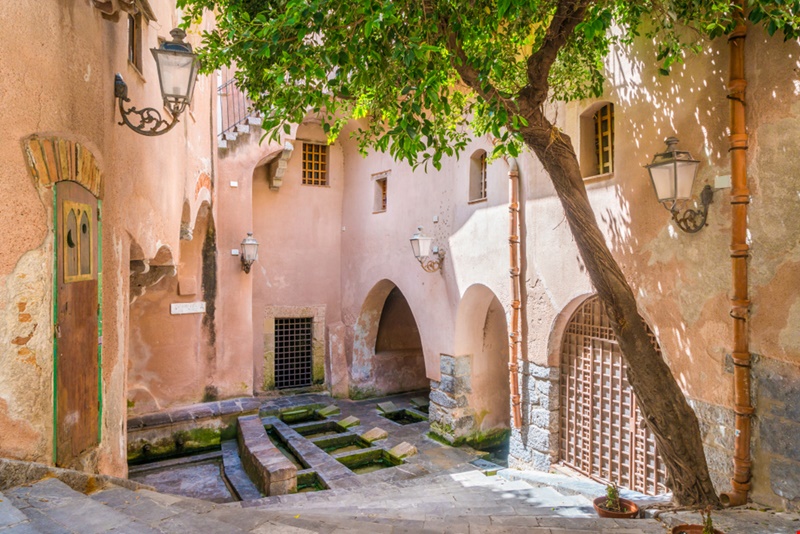
In stead of fining people for doing it where they shouldn’t, some towns and cities decided to provide people with their own spot were laundry could be done without polluting the fountains.
Like here at the Cefalù washhouse in Italy, where through hydraulic engineering water would be redirected to this laundry spot, although what you see is from the early 16th century, it replaced an earlier one.
“English bathhouses were generally supplied by water carriers. A complaint by the indentured Thomas Bunny charged that his mistress, who kept ‘‘stews’’ on the far side of London Bridge, had set him ‘‘all manner of grievous work, such as carrying water in tynes, and while thus employed he fell down and received a permanent injury.’’
On to the bathhouses, one of my favourite subjects.
I’d love to know the source for the claim that English bathhouses had to be supplied by water carriers as that seems odd and unusual, many bathhouses were built in places where they could rely on easily getting water, they needed so much every day that carrying it from well to work seems like a strange choice.
Also the text shared here might just mean carrying water from a spout in the building or just outside to the tubs in stead of from a fountain to the bathhouse.
Side note: both bathhouses and brothels with bath services were called stews but were very different places you really don’t want to mix up when you travel back in time.
Don’t ask.
But them having the same name may in part be responsible for people thinking that all or most bathhouses were also brothels, looking at you Kingdom Come Deliverance developers 😉
So I’m not sure about what happened here, was poor old Thomas being ordered to carry water to fill bath tubs in a bathhouse or just carrying water for regular use in a brothel?
“On occasion, however, irresponsible individuals attempted to use the fountains themselves for bathing. In 1282 Siena fined a certain Ciampolino three lire for an illicit bath that he had taken in Fonte de Follonico.”
I just can’t get enough of random medieval people only being remembered for being naughty.
Come on Ciampolino, Cia darling, what were you thinking?
Funnily enough I literally just saw a video on tiktok of tourists getting fined for jumping in the Trevi fountain.
“To the extent that public fountains provided more convenient sources of domestic water, they may have had some impact on the frequency of home bathing and washing. Modern studies show that one of the benefits of providing public water systems to traditional societies is an increased incidence of washing when domestic water is more readily obtainable. The overall frequency of medieval washing and bathing is impossible to quantify (and doubtless showed considerable variation between social groups and individuals), but one gets the impression that washing the hands and face and even bathing the entire body became increasingly common activities in the later Middle Ages (albeit still infrequent by modern—or Roman—standards of personal hygiene).”
THIS!
This is what I’m always going on about.
When a historian decides to, usually for the first time, seriously study a very specific subject, we suddenly get a whole new perspective of all kinds of aspects of Medieval life.
Here we go, when we realise that medieval people had more access to water than we thought, the idea of it being extremely difficult for them to be clean becomes less believable.
I don’t agree with the authors last line though and here we have to keep in mind that the book was written over 2 decades ago, before ‘Community, Urban Health and Environment in the Late Medieval Low Countries’ by Janna Coomans, Het middeleeuwse openbare badhuis’ by Fabiola van Dam or Communal Health in Late Medieval English Towns and Cities’ by Carole Rawcliffe were published that all support the idea that bathing & washing was quite frequent, washing was a daily habit and people bathed weekly or more.
We also have to remember that the image of the Roman era often only applies to a few Roman cities and not the poorest people.
In much of the Roman empire people didn’t have the fancy infrastructure they had in Rome and even in Rome the city was so large but also overpopulated that the common people living on the 5th floor of an Insula in some slum had to walk down many stairs and quite a few streets to get to one of those nice public fountains or a public toilet.
Making it perhaps more believable that they actually did empty chamber pots from their windows, something medieval people are usually accused of.
“Frederick II’s Sunday bath was considered scandalous by his contemporaries in northern Europe, whereas King John of England, whose household accounts indicate that he took ten baths within six months, was almost certainly more fastidious than most men of that time. The building accounts of John’s successors, however, show that elaborate baths came to be considered standard features in royal palaces and manors during the later thirteenth and fourteenth centuries.”
This bit I’m also not so sure about.
I’ve looked for contemporary sources where people were scandalised by his regular bathing and found none, I think the author here confuses the rumours spread as propaganda by Frederick’s enemies about his lavish lifestyle and perhaps assumes that this must have had something to do with his bathing.
But I’m yet to find evidence for it.
Come to think of it, I never found any contemporary evidence of him bathing weekly, earliest mention of this story I discovered dates to 1922!
As for King John’s records, we do have (incomplete) records that tell us that he employed a dedicated travelling bath attendant with the cool name of William Aquarius, on a continuous daily retainer for almost about 16 months.
William prepared baths for the king, probably bathed the king, etc.
This was a specialised job, these weren’t just regular baths.
The records only tell us about these baths, but there’s no way of knowing if these were the king’s only baths.
He may have also enjoyed regular basic baths prepared by his servants, bathed in rivers & canals (popular among nobles in summer & after hunting), visited a bathhouse when arriving in a city or had a simple sponge bath.
On to a dirty subject:
“Some cesspits would have been simple, unlined holes in the ground, but others could have different types of lining: excavated examples range from a barrel-lined shaft to elaborate stone-lined chambers. Sometimes a wooden pipe carried the wastes from the privy to a more remote cesspool. Latrines could be situated next to houses, in courtyards, or out in the backs of tenements. London building ordinances required that unlined cesspits be situated at least 38/= feet from the property line, whereas stone-lined pits could be 28/= feet from the neighbor’s soil, but problems associated with latrines remained a frequent source of conflict between neighbors, to judge from the Assize of Nuisance complaints.”
Toilet talk!
I won’t shout sewers again.
“Some cesspits were dangerously deep: Richard le Rakiere, seated on a latrine in his house, was drowned in a pool of sewage when the rotten planks suddenly gave way.”
Oh no, poor Richard, what a way to go, what a way to be remembered till the end of time.
“One of the most spectacular public privies was Whittington’s Longhouse, built thanks to a charitable bequest by Richard Whittington, the famous mayor of London. The longhouse had two rows of sixty-four seats each, one side for women and one for men. The underlying gully, which emptied into the Thames, was flushed out into the river at high tide.”
Look at that, massive free public toilets for men AND women.
Can you imagine ladies?
Someone actually thinking about us when building public toilets?
Again I can think of a few cities today that could learn from our medieval ancestors…
“The excavations at both Southampton and Worcester revealed numerous small pieces of cloth among the debris in the latrine pits. Such scraps of material may have served ”to wipe the nether end,” as did the cloths in Duke Humphrey of Gloucester’s luxurious privy. (The ducal chamber also included cushions, hand-basins, and towels.) It is also possible that pieces of cloth would have served as sanitary napkins for medieval women.”
Archaeologists also found straw in cesspits, which made some wonder if this may have created a sort of dry compost toilet effect, reducing bad smell.
Although of course we won’t know if medieval people knew this, if they used straw on purpose for that or if it was just a happy side effect of wiping with straw.
You can read that paper here.
“According to the chronicles, certain members of the papal marshal’s retinue were caught washing a puppy in one of the neighborhood fountains, the Fontana di Pianoscarano, whereupon they were scolded by one of the local women for polluting the drinking water. Tempers flared as the argument escalated, the woman was killed, and the entire neighborhood rose in a civic insurrection against the foreign members of the papal court in Viterbo. The ensuing riot was violently suppressed at the cost of many lives. To punish the unruly neighborhood, the fountain itself was demolished. Although this incident was unusual in its violent escalation and political implications, the threat of a public outcry among outraged neighbors must have effectively deterred many an abusive practice at the local fountain.”
Goodness me, what a story!
“In London William Bonet, the constable of Baynard Castle ward, was assaulted by an apprentice when he stopped him from emptying a handcart full of rubbish and filth into the Thames. Edmund le Coteler, relieving himself in the street, drew a knife on two men attempting to guard the streets of their ward from ordure; Beatrice Langbourne, upon being arrested for casting filth in the street, accused alderman Simon de Worstede of being a ”false thief and a broken-down old yokel.””
We’re told that the Thames in Medieval London was filthy and used for dumping waste in, which is true but perhaps not the way we think as the story of Mr Bonet shows.
And yes, there are many stories of people getting into arguments, fights and even being killed over urinating or littering in public.
“The majority of medieval water systems, however, went out of use as the result of gradual decay and abandonment or were replaced with new waterworks in the postmedieval period. Surviving systems were likely to have their medieval components replaced during periodic overhauls. The pipes supplying the lavatorium at Maubuisson, for example, had apparently stopped flowing during the Hundred Years’ War.”
Important detail here is that although things decayed and were abandoned, they were also often replaced or adapted.
Something historians sometimes forget to mention when writing about the demise of Roman infrastructure…
I shared some of the bits in the book I found most interesting, predictably these parts were mostly about how they debunked some of the stubborn myths about medieval hygiene.
But the book is of course about a lot more than just that, it goes into great detail about how all these water related things worked, developed, were used, etc.
It’s a very interesting book that I enjoyed reading a lot, even though I’ve been studying this subject for decades, it was still an eye opening read.


This books sounds great.
LikeLiked by 1 person