
This article was originally a thread on social media, which is why it is formatted with lots of images and short responses.
The text is about the image below that paragraph.
Let’s review a kids book from 2017 called “Gross facts about the Middle Ages”.
Why am I doing this to myself?
The cover alone is promising…
You can read the book online here;
https://archive.org/details/grossfactsaboutm0000vonn/mode/2up

I like that every page literally has filth dripping from it.
Yes people farmed by hand, yes that was dirty work… which is why they used tools, not just their hands!
Yes, most people bathed just once a week… BATHED, as in had a BATH.
They WASHED on other days… how often do you have an actual bath?
You know, submersing yourself in a tub full of hot water?
What, not every day?!
Weekly as well perhaps?
Yes I know, we shower on the other days of the week, medieval people did the same, except of course that they didn’t have showers but in stead just scrubbed themselves clean with water from a bowl.
Yes yes, I’m calm, honest.

Bath water came from wells and springs, which is pretty clean water.
Sure, some bathed in streams or washed with water from those streams, but they generally knew which streams were used for dumping waste into or where this dumping was done so they bathed upstream.
Most towns had strict rules and even laws about where you could dump your waste, a big stream was often chosen that had a good current which would take the waste out of the town every ebb because Medieval people weren’t morons.
If you threw your filth in at the wrong spot, the wrong time or the wrong stream, you could be in serious trouble;
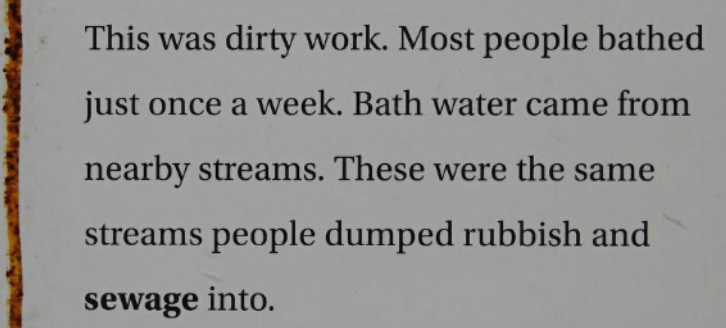
Oh its a fact, so it must be true…
Yes, most houses were cramped, at least according to our modern standards.
And yes farmers who couldn’t afford to built a barn would share their house with cattle, but not their living spaces, again; medieval people weren’t morons.
The cattle would be in a separate part of the building, behind a wall or partition, they wouldn’t be walking around the place freely, share a bed with the humans or make a mess of the place:

More about people sharing houses with cattle here;
https://fakehistoryhunter.net/2025/11/15/did-medieval-people-share-their-homes-with-cattle/
Nice to see that medieval people get some credit.
Yes people washed (not just hands) daily, combated lice, etc.
How many sets of clothing peasants had is impossible to say, likely they had at least 2 sets, one for when the other was being washed, possibly three, one for wearing, one that’s being washed, one for Sunday and special occasions.
It’s also quite likely that that they had several items of clothing that could be mixed & matched into more than 3 sets, yes clothing was very expensive but there was also a big trade in second hand clothing going on and the wealthy loved to show how generous they were by donating their old clothes.
Stiff & itchy? Huh?
Why would it be stiff and itchy?
They wore linen underclothing that would avoid that sort of thing, I should know, I’ve worn Medieval (replica) clothing during my job at an open air museum;
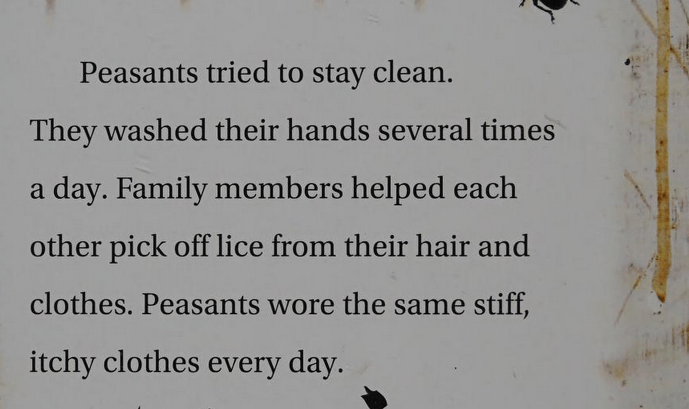
I guess you can say that, but if this was my book I’d add here that this was only the woollen over-clothing, comparable perhaps to our winter coats.
How often do you wash those?
Natural wool is pretty dirt resistant btw, brushing it is often more than adequate;

EWWW!
I’m all for traumatising kids, the films, tv shows and books that were once too scary for me and caused nightmares, are today the ones I have the fondest memories of.
But that photo needs a trigger warning.
Medieval people had relatively good teeth, they cleaned & brushed them, even used whitening & cleaning products.
Their diet also contained no/little refined sugar/starch/carbohydrates/tobacco/caffeine which was good for their teeth.
Their teeth did have a lot of wear and of course if you did have serious dental problems, there wasn’t much that could be done:

Gelatin, it’s called gelatin.
Yes how it’s made is pretty gross, but we still use it today and describing it as “boiled cow hooves” is factually correct but it’s also a bit odd to avoid calling it gelatin.
Is this how the author would describe Jell-o or gummy bears?
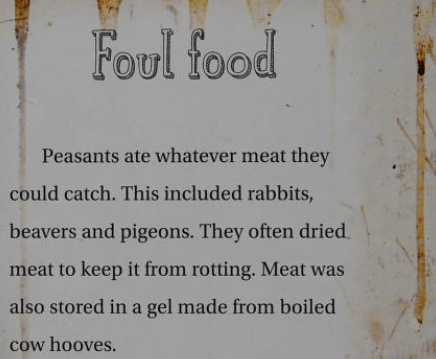
Yeah but nay.
The key word here is “variety”, but when you read it like this it sounds like they actively avoided eating fruit & veg.
But they ate both, it was part of the diet.
Without global trade they were limited to regional and seasonal fruit & veg which didn’t leave them with as much choice as we spoiled modern weirdos have but it was still a lot more diverse than the author and many people today seem to think:
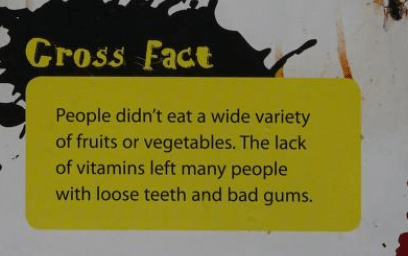
Most disgusting trencher I’ve ever seen, and I’ve seen a few.
When they say they used old bread, they didn’t mean mouldy bread, just bread that was a few days old and a bit harder than fresh bread.
Stale does not automatically mean that new lifeforms started building advanced civilisations on there;

Some neighbourhoods in some crowded cities were sometimes smelly and filthy, just as its the case today and has always been.
Roman cities were much bigger and more overpopulated, filth was a much bigger issue then than during the middle ages, but somehow we rarely hear that mention in books about the Romans do we?
Either way, people have never liked this, even medieval people were upset by stinky mess, it’s almost as if they were just humans like us…
So they complained and these problems were solved, it was not an continuous state.
They had strict laws about pollution & waste. They also had street cleaners.
Things didn’t get out of hand till mostly after the middle ages when cities became permanently overpopulated and the industrial revolution had resulted in a lot more waste & pollution, yes, Victorian cities were filthier than most Medieval cities;
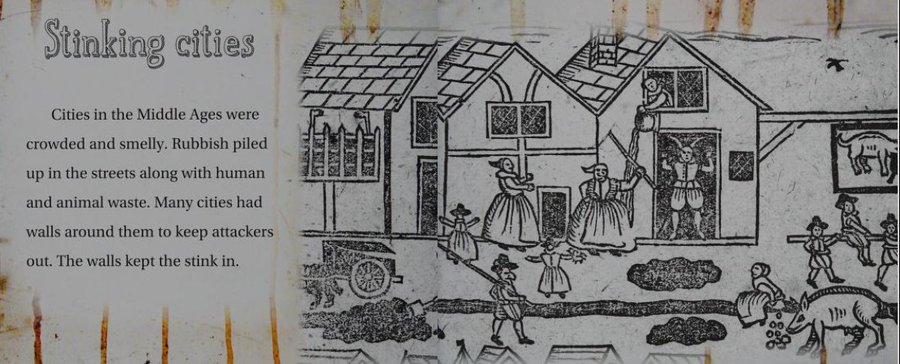
Just so you know, that image is not from the middle ages, it comes from the 1636 broadside ballad ‘The coaches overthrow‘, a visual satire designed to shock, entertain, and promote a moral or political point, a sort of protest or celebration regarding the temporarily restriction of hackney coaches in London.
The image shows the supposed chaos & filth that would happen if the coaches made it impossible for people to clean streets and have their waste collected.
So not really an accurate depiction of what streets were like back then:

Again something that was a common procedure during much of our history and in many places on earth is mentioned as a typical medieval thing while it’s rarely mentioned when talking about other eras and cultures.
And in a way it’s still done today although known as therapeutic phlebotomy;

Once more a book forgets to mention that the black death was killing millions in Asia, the middle east & Africa as well, before it even reached W-Europe!
Do they think that those other regions of the world don’t matter, do they just want to support their bias about how awful medieval Europe and only Europe was, or did they just not know:

Well at least the rats aren’t blamed this time:
When people have to use art that’s from a completely different era to illustrate a claim, that’s a red flag.
When they have to use art made centuries later about not even the era they’re talking about, that’s a redder flag.
Couldn’t find the source for this illustration, appears to be made in the 2nd half of the 20th century and clearly depicts a scene set long after the middle ages;

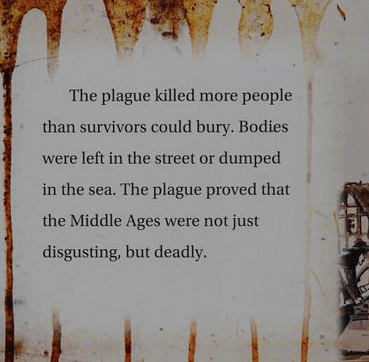
How did the plague prove the middle ages were disgusting?
See, this is the corner you find yourself stuck in if you don’t properly research the origin of the plague or how it actually spread.
The author clearly still believes the plague was spread because of there being rats everywhere and nobody ever bathing.
And what how about the countless plagues that happened in all those other places and eras?
The plague proved the middle ages were deadly?
Did… did someone think the middle ages OR ANY OTHER ERA EVER were not deadly?
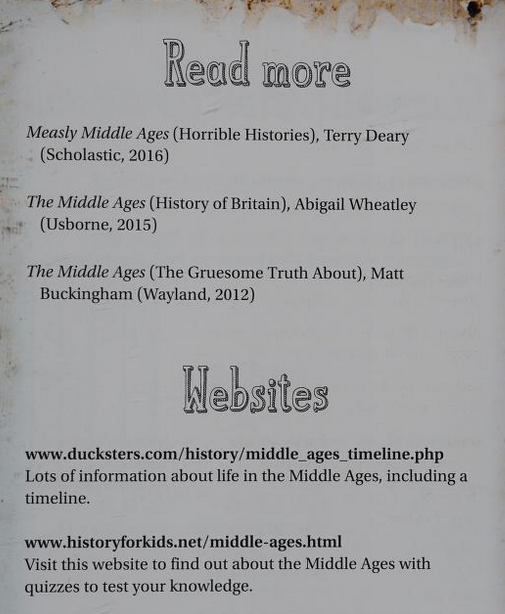
Read more?
Oh I will… I will…
On the back they mention chamber pots and toilets, hey, they’re not in the book!
Unfair.
Oh dear… there are more in this series…

Sigh.
Another reminder for parents & teachers to keep an eye on the books your kids read.
Historians learn new things and perspectives change all the time, history books can become outdated real fast.
For more up to date and factual information on medieval hygiene, check out this list of links;
If you enjoy reading my reviews you can find more here;
https://fakehistoryhunter.net/2022/11/14/my-reviews/
 Fake History Hunter
On the use of stale bread front to make a trencher, this is not that far divorced from the (still current) European practice of using stale bread in cooked recipes, whether added to soups, or reheated & used with “wet” ingredients. Good, properly made, bread goes hard before it goes off, so using it to soak up juices & sauces is both a good way to avoid waste, and also a method for getting the best out of the bread *and* the sauce.
LikeLike
Absolutely, I grew up with stale bread based snacks, it’s more the way the bread looks in the book, disgusting and mouldy.
LikeLike