
This is yet another relatively well known image that gets shared quite a lot when people try to convince us that mucky medieval folk were just flinging poo out their windows like it was an Olympic sport, but is that what it really depicts?
Let’s have a look.
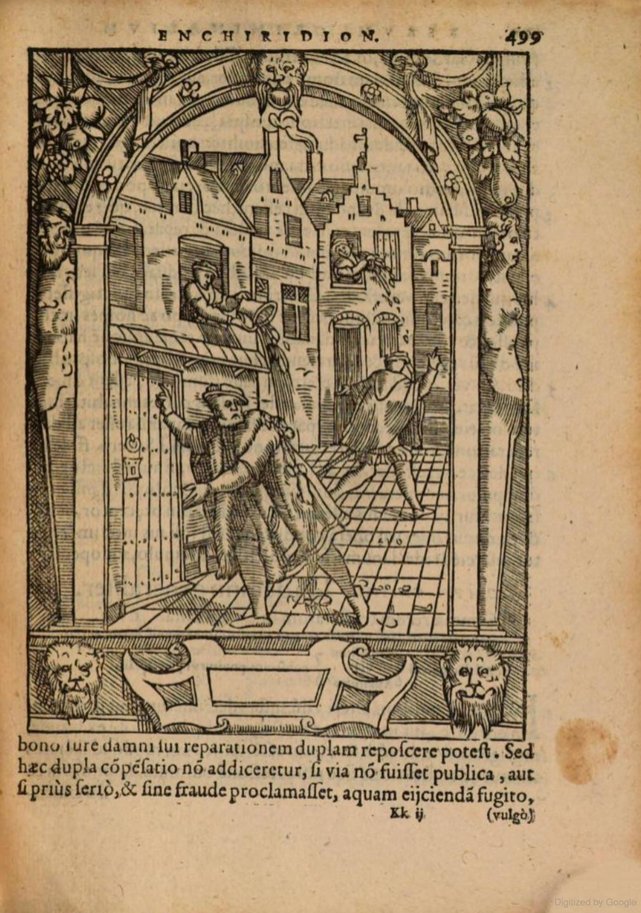
The image comes from ‘Praxis rerum criminalium’ by Joos de Damhouder, 1554 (a text he pretty much completely plagiarised).
So technically it’s not even medieval, it comes from the era when cities were becoming overpopulated, yards & gardens were being replaced by buildings, there was less room for outhouses and things in some cities were getting worse when it comes to hygiene.
But of course few people care that this source does not really represent the middle ages, not that one single image would represent a 1000 year chunk of history in a rather large region of the world of course, but still.
Still, people are clearly emptying chamber pots from their windows onto people’s heads!
So at least this image actually depicts what people claim it depicts.
The book ‘Praxis rerum criminalium’ (The Practice of Criminal Things/Matters) is about criminal laws & procedures. And guess what, it’s all about the very strict fines people got when they did naughty things!
Which makes it a bit ironic that this image is regularly used to support the claim that people were perfectly fine with this sort of behaviour.
Imagine if future people misunderstand and judge us by what illustrations in our books on crime and antisocial behaviour depict…
Here is the text related to the image:
Now, my knowledge of Latin is non-existent so I had to use some software to translate this, so don’t put too much value into the translation and feel free to check & correct me on this.



“If anyone from his windows, or from his doors, or from those of another, should throw filth, urine, excrement, or any whatsoever things, or things unclean or harmful, into the street or public way, whereby the hat of one passing by, or his cloak, or any other garment might be torn, stained, or spoiled that passer-by thus injured is by good right able to demand double reparation of his damage.
Law 1, at the beginning, Digest: “On those who threw down or poured out.
But this double compensation would not be awarded, if the way had not been public, or if beforehand he had seriously and without deceit proclaimed, “Flee!”; (commonly) Garde l’eau.”
This text both supports & debunks the claim of people emptying chamber pots into the street being common & acceptable, let me explain.
First of all, it is clearly a judgement of such behaviour, but the behaviour itself is not punished, you just need to pay someone if you damage their clothing when you forget to warn people for throwing stuff out of your window.
And nobody cared if you did it on your own land.
This suggests that throwing filth out your window was fine but making people’s clothing dirty was not.
Mind you, if you ruined an item of clothing, paying twice what it cost to clean or repair it could end up being quite expensive.
What is also very interesting is that it mentions an earlier use for the often repeated cry of “Garde l’eau“, in English better known as “Gardyloo“.
This was reportedly a common cry in early 18th century Edinburgh, but now we know it existed in the 16th century outside Scotland as well although the Scottish form was likely a regional faux-French variant.
So at first sight it seems that we finally have evidence of people being fine with emptying chamber pots out of windows as long as you shouted a warning first… but…
There’s a very interesting detail in the text that I’ve made bold for you, this alludes to a ROMAN law…
The original text continues to explain what would happen if you threw other kinds of rubbish into the street, it’s clearly something you weren’t supposed to do.
But our focus is on emptying chamber pots, you can find the full text of the book in the sources if you want to read about other kinds of polluting.
Now back to the intriguing mention of Roman law:

Again, I can’t read Latin, I’m no expert on Roman laws or even Romans in general, so please fact check me if you can.
But… if I understood correctly “L.I. ad exordium, ff. de his qui deiecerunt, vel effuderunt.” alludes to Roman law.
It was very common for Medieval & Renaissance people to adopt, copy and continue to use Roman laws, although of course, altered over the centuries.
And this is still a thing today!
We cloggies (Dutch people) still have Roman remnants in our law books today.
This kind of stuff hurts my brain, I’ve dated a lawyer for a short time, but goodness me this stuff is complicated and/or very boring.
But, this 16th century text regularly mentions this Roman law, so I tracked it down.
Ulpianus, On the Edict (Edictum), Book XXIII, Digest 9.3.0: De his, qui effuderint vel deiecerint (Corpus Iuris Civilis, 533 AD) (source):
Praetor ait de his, qui deiecerint vel effuderint: ” unde in eum locum, quo volgo iter fiet vel in quo consistetur, deiectum vel effusum quid erit, quantum ex ea re damnum datum factumve erit, in eum, qui ibi habitaverit, in duplum iudicium dabo”
Translation: (source)
The Praetor says with reference to those who throw down or pour out anything: Where anything is thrown down or poured out from anywhere upon a place where persons are in the habit of passing or standing, I will grant an action against the party who lives there for twofold the amount of damage occasioned or done.
Although the text above was published in 533AD, it was a compilation of texts written by Ulpianus, who died in the 3rd century AD.
I can think of only two types of waste that can be effusum (poured) out of a window are common household liquids (like dirty water from washing, cooking or laundry) and urine.
So the law about not throwing waste & rubbish out of windows into streets is not a Medieval one but a Roman one, this makes sense as Roman cities were generally a lot more urbanised, busier, more overcrowded, than most Medieval cities for most of the middle ages.
Roman cities had apartment blocks, narrow streets, slums, etc. while most Medieval cities had houses with gardens & backyards with space for outhouses, cess pits or dungheaps and often not even a second floor.
When we think of Roman cities we think of sewers, bathhouses, latrines, etc.
But many Romans wouldn’t have had easy access to these, if you lived in a tenement building (insulae) you could have a tiny room on the 9th floor with no running water, no toilet, not even something to cook on.
Yes, they’d have to carry their chamber pot down 9 stairs and then find a latrine or something to dump it in…
Under those circumstances I find it a lot easier to imagine someone chucking pee out the window in a Roman city than in a Medieval city.
But… what is interesting is that the Romans didn’t think they had to specifically mention urine & excrement in their law.
Somewhere along the line, possibly the 13th or 12th century, when the old Roman laws were brought back into use, or at least were written down again, someone decided to make the general description a bit more precise.
We don’t know why.
Yes, if you want to believe medieval people were a mucky bunch, you probably want to assume this was done because out of nowhere, for no real reason, those dirty Europeans decided to start throwing poo & pee all over the place.
Sorry, although I can’t prove you wrong, it is very unlikely.
As I already explained, Roman cities were more likely to deal with this pollution issue than most Medieval cities.
More about this in the sources.
But here’s a nice Pompeii graffiti that explains a local law:
‘Marcus Alficius Paulus, aedile, (declares): anyone who wants to throw excrement in this place is warned that it is not allowed. If someone shall denounce this action, freeborn will pay a fine of […] denarii, and slaves will be punished by […] lashes.’ (source)
And there are other Roman laws and texts that mention dumping excrement and/or urine in public places.
So what have we got so far:
We know quite a few Roman cities had a lot of problems with pollution & waste, we know that this was less of an issue (but still an issue) in most Medieval cities for most of the middle ages.
We know the Romans had laws about throwing waste out into the streets, we don’t know when these laws were first written but they go back to at least the 2nd century.
Somewhere along the line Medieval clerics (possibly Placentinus in his Summa Institutionum in the 12th century) copying & reviving the Roman texts felt they had to make the text they were interpreting a bit clearer, add an example of what was meant here, etc.
After all the old Roman texts were often used as an education tool in Medieval Europe, especially in the newly invented universities.
Placentinus was born in Piacenza, in Italy, which likely would still have been relatively Roman at that time, he also taught at universities.
I think that it is likely that he knew very well how this Roman law was interpreted and used in daily life and that this is how it had been since Roman times.
But that’s just an assumption.
Conclusion:
I think that the Romans had trouble with people chucking human waste out of windows into the streets and made a law to deal with it.
This law was vague, it was about dumping any old waste, but this would have included urine & excrement.
During the middle ages these texts were expanded, not because people had suddenly, out of nowhere, started throwing human waste into the streets but because the clerics felt the Roman law needed a bit of explaining and to perhaps make sure that people knew that kind of waste was also part of this law.
Clarification, not adaption.
No matter how you look at it, using the image above or that ancient law to prove that Medieval cities were somehow uniquely disgusting in history and that chamber pots were emptied out of windows into the streets below is disingenuous.
Sources:
- ‘Praxis rerum criminalium’ by Joos de Damhouder, 1554
- Digest 9, Law of Justinian (in Latin)
- The enactments of Justinian, the digest or pandects, book 9 (in English)
- Insulae: how the masses lived, Waste, washing & hygiene, University of Cambridge (pdf link)
- Hygiene in Roman law – burials, sewers, and water system, by Valeria Terezia Danciakova
- Medieval Myths Bingo
- Book review: ‘Community, Urban Health and Environment in the Late Medieval Low Countries’ by Janna Coomans
- Book review: ‘Urban Bodies: Communal Health in Late Medieval English Towns and Cities’ by Carole Rawcliffe
 Fake History Hunter
“Roman cities” did not all have those problems – Rome specifically had them, because it was by far the largest and densest city in the empire.
LikeLike
I think it’s your argument that’s disingenuous. The mere presence of the law suggests it existed to penalize an existing act.
Beyond that, the exceptions provided in the law (you can throw waste on roads people don’t usually pass, you can throw it after shouting a warning) make it extremely likely that the laws existed and evolved around a commonly accepted practice. So much so, the law spelled out middle grounds for dung chuckers. Definitely not a remote incident.
LikeLike
Did you miss the bit where it turns out that this was a ROMAN law that was just renewed all the time?
Or that the shouting a warning was about unspecified liquid “waste” which was most likely just to be dirty water meant for the gutter?
LikeLike