
This may sound like a boring book but for me, a historian obsessed with debunking the old myth that medieval people were dirty, rarely bathed, etc. it’s quite a fascinating read and I think it has plenty of interesting details in it that most people will find interesting.
So as I read the book I marked fascinating parts, I’ll just share the best here in this review.

Medieval hygiene and, well, generally a more serious look at what medieval life was really like for the common man, has only been given the proper attention it deserves in the last couple of decades, before then historians often just copied what historians had said before them, repeating Victorian opinions.
Luckily this has changed and recently a couple of books have come out that have actually researched original medieval records and shown us a whole different perspective.
But most of these are about the high & late middle ages.
The early middle ages is still a bit neglected when it comes to this topic and the idea that after the Romans Europe pretty much collapsed and returned to an almost prehistoric way of life is unfortunately still quite common even though historians have been trying to explain to people that and why we no longer call that era the “dark ages”.
But what about the water technology like aqueducts, bathhouses, etc. what happened to that when the Romans finally went home?
Romani ite domum!
A topic that’s doesn’t seem to have been given a lot of attention by historians, so I was very happy to see Magnusson start the book with it.

I find this fascinating, it changes the image a lot of us (still) have, yes, there was neglect & destruction, but also continuity, restoration & eventually replacement by new, sometimes better systems, like underground pipes & conduits in stead of aqueducts open to the elements.

I sometimes feel that when people talk about the early middle ages, the chaos and “decline of civilisation”, they’re only looking at England or even just London, where things admittedly were a tat dire for a while.
But that situation was not representative for the rest of Europe and this seems to support that idea a bit.

Just a couple of examples of medieval people doing impressive things with water in what some still call the “dark ages”.
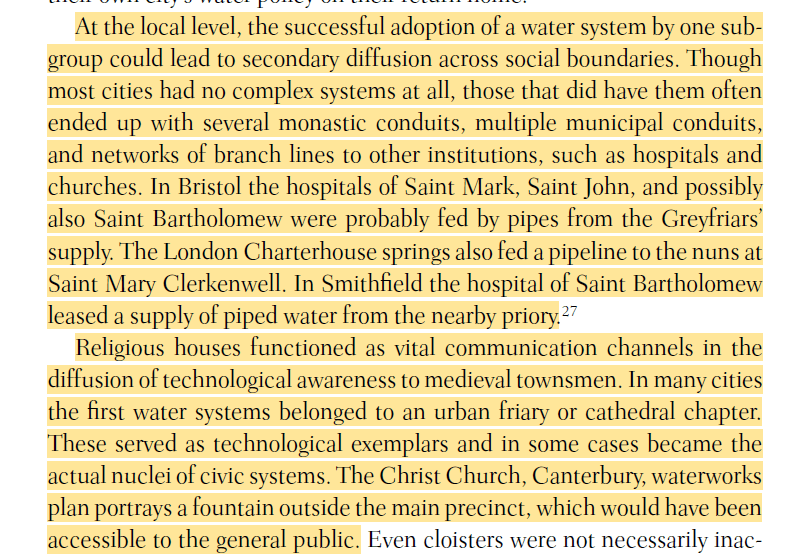
Complex water systems in Medieval Europe often started at monasteries, they needed running water for their toilets, cooking, cleaning, industry, etc.
And I guess God has a lot of money, so they could afford it before others could.
But as the book explains, it wouldn’t be long till neighbours started asking if they too could perhaps connect a few pipes to the system the monks were using.
And before you know it there were fountains and private channels everywhere and locals got a little aggressive when you wanted to cut them off…

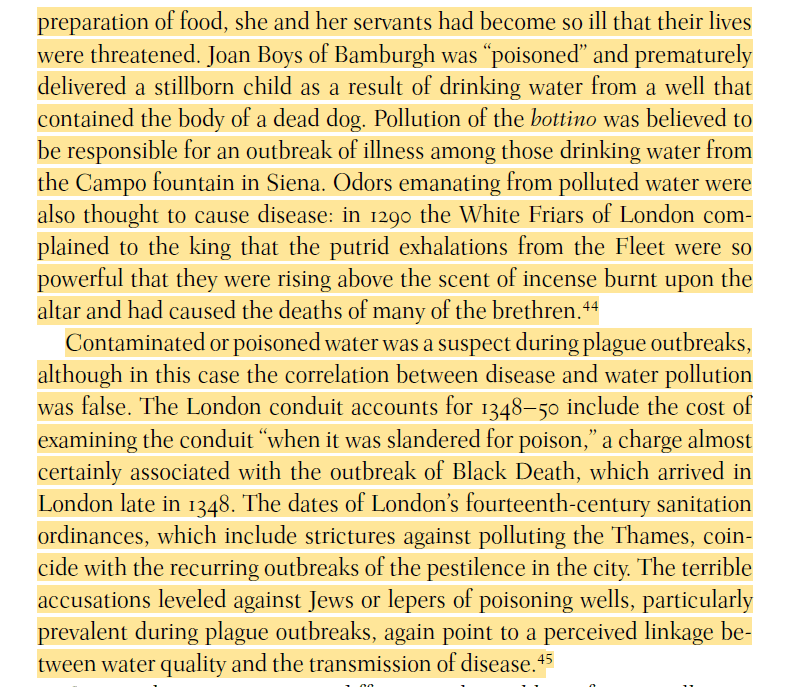
This is a very important bit as it so clearly destroys the idea that some people still have involving medieval people just drinking dirty water all day and not caring about it being filthy.
Of course it’s nonsense, think about it.
If you drink bad water you’re going to find out that this was not a good idea REAL FAST.
That’s a lesson you only need to learn once.
In reality medieval people got very upset when someone polluted their water, they knew this would make you sick and could kill you.
Remember, they believed in the Miasma theory!

Yes, some cities/towns/villages used streams & rivers to get rid of waste, in many cases it simply was the only option.
Manually carting it out to the countryside was also done, but when you’re dealing with the waste of hundreds, even thousands of households every day, that won’t work.
But people still weren’t stupid, they made laws & rules about when you could throw filth in the river, making sure that it happened when ebb or flow would take the rubbish away to outside the city.
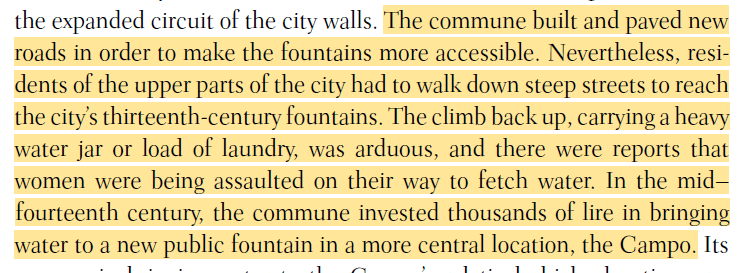
Men, being a nuisance to women, some things never change.
In many places the carrying of water wouldn’t be as big a chore as one might think, wells were quite common, especially in central and western Europe were groundwater is relatively close to the surface.
Archaeological evidence from a German village shows several wells in people’s gardens, sometimes shared between households, as well as a couple of public ones.
I have done a little research into this but it would be great if someone wrote a paper on it, because finding out how common wells actually were in Medieval Europe would be fascinating and could also play a big role in dealing with some old myths & misconceptions.
After all if you only have to walk 3 meters into the plot behind your house for clean water to cook, clean or bathe in, in stead of having to walk 3 miles, will make it a lot more likely for people to wash themselves more often.

The diameter of a goose quill can be 2-6 millimeters, a bit like a drinking straw.
Which may seem like not very useful, I mean how much water would you get through that?
But if it had a bit of pressure, it would still fill your jug pretty quickly and it would be less work than lowering a bucket into a well and pulling it up again.
Still, it’s not very generous.

Typical!
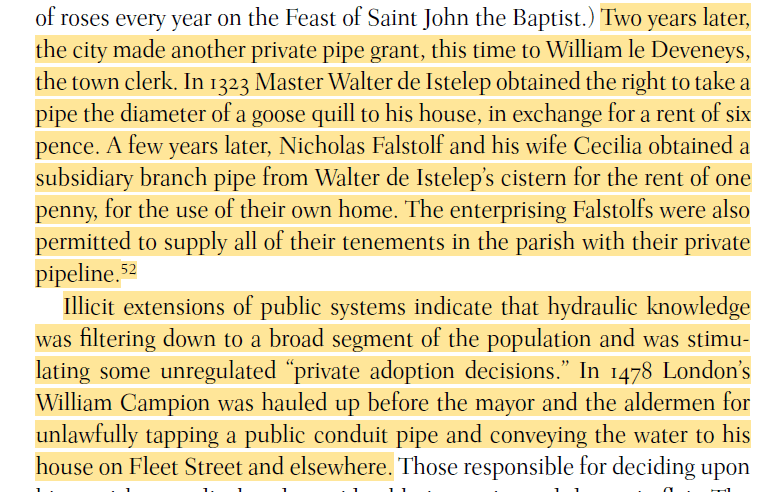
Again the goose quill!
But the small tube is starting to make sense, after all, if everyone suddenly wants running water in their homes, soon there won’t be any water left for the rest.
So one can’t be too generous.
But this text is telling us something most of us would never associate with the middle ages: not just running water, but running water in the houses of individuals, not just rich ones either.
Everyone seems to have been trying to nick water, all those dirty dumb medieval people who not only never washed but were literally terrified of water… ahem… were risking punishment to steal water and installed running water systems in their homes…

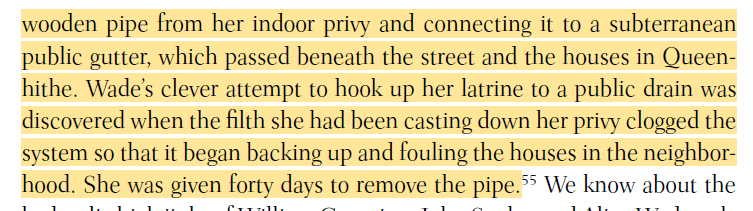
There we go, regular villagers with top of the range, fancy pansy running water in their dwellings!
And poor old Alice, she’s been mentioned in quite a few books, imagine this being the only reason you’re remembered centuries later…
But actually, well done Alice.
A medieval woman who had an indoor toilet that was connected to a “subterranean public gutter” (I’m always a bit confused when authors seem to avoid calling sewers sewers), I mean she deserves applause as well as a warning.
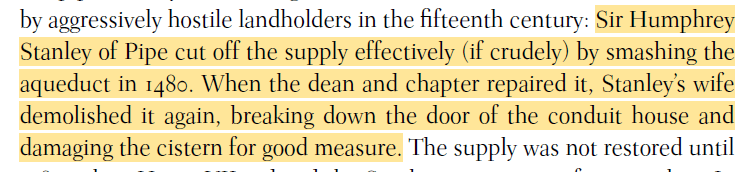
This just makes me laugh.
I can just imagine lady Stanley kicking the door in.
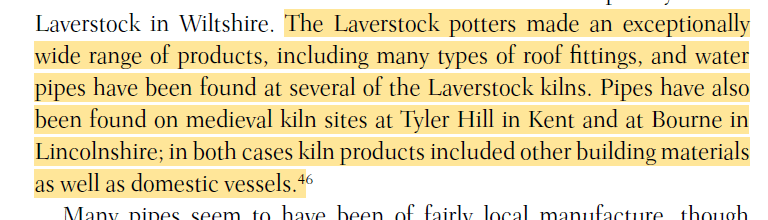
Yes, they had water pipes, nice earthenware/clay/ceramic ones but also wooden.
In 1501 the town of Freiburg ordered seven thousand pipes to be made.
Again something we all have no trouble believing to have been a thing in ancient Greece, the Roman empire or during the Renaissance, but when you tell people they were also around during the middle ages…
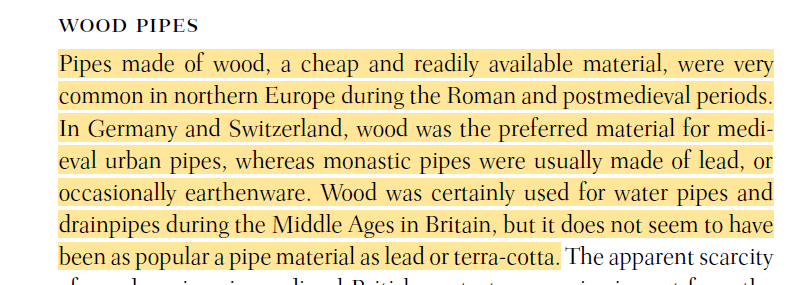
And just to bring the Roman era and the middle ages a bit closer we have this interesting little fact: yes the Romans also had wooden water pipes, just like the medieval folk.
Did you note the use of the words “very common”?
Not sure about the use of the word postmedieval here, did the author perhaps mean post-Roman?
Because she later talks about wooden pipes in the middle ages.
Either way, it’s all true, wooden pipes were used in Roman, Medieval and postmedieval times.
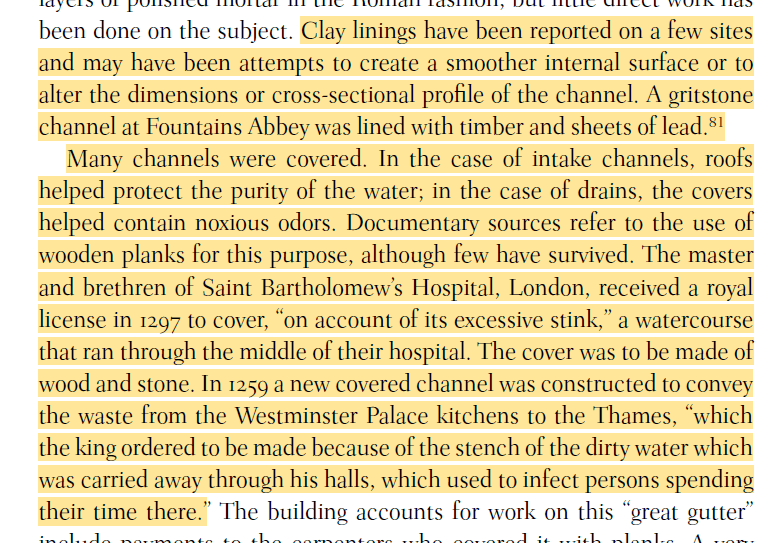
Here is that thing where we don’t dare to call medieval sewers sewers again.
I mean come on, clay lining, covered channels, lined with timer & sheets of lead, how is that not a sewer?
As far as I’m concerned a drain/gutter used for transporting waste or water can be called a sewer when it has been covered or even buried.
But I’m not a plumber, so feel free to correct me on this.

A manhole!
How is that not a sewer?!
Either way, this bit shows us that medieval people really didn’t like stinky stuff, besides miasma, it’s just not nice, so when a gutter/drain became a problem, they covered it!
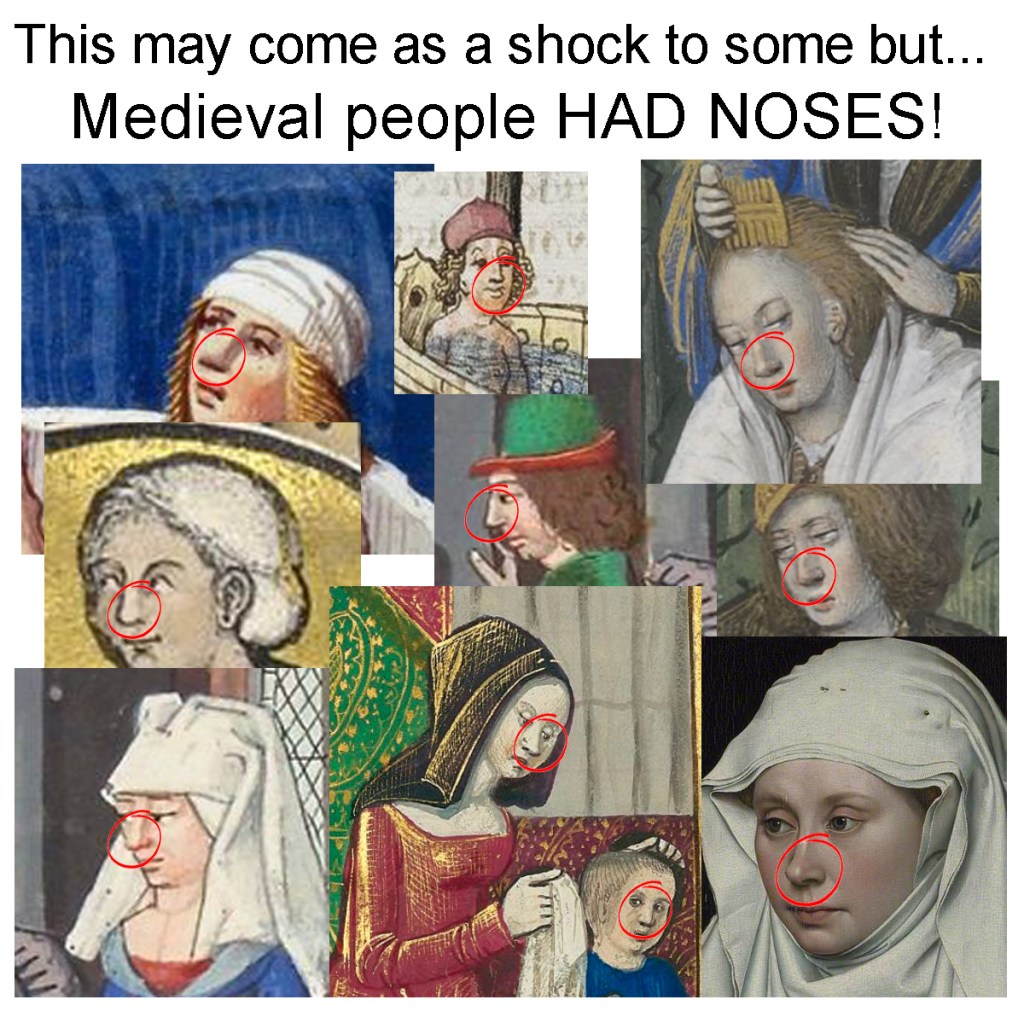
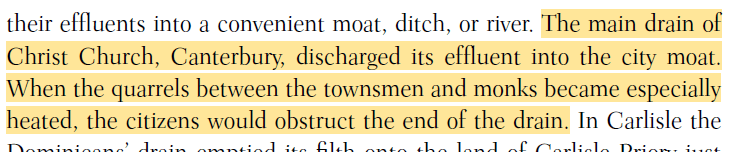
Now that’s just evil 🙂
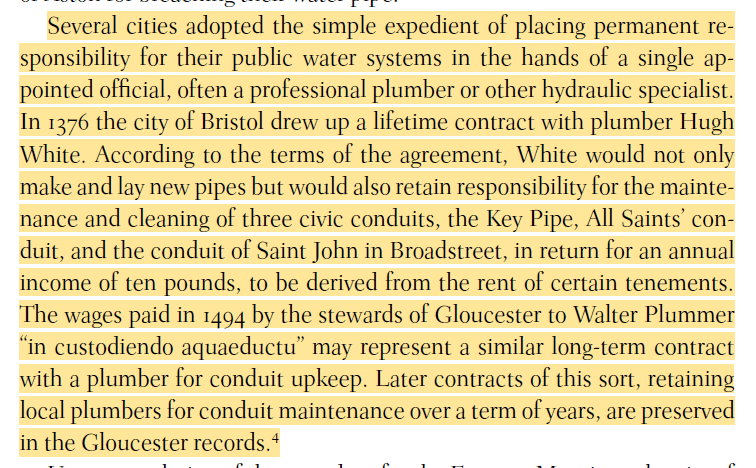
That all sounds very professional.
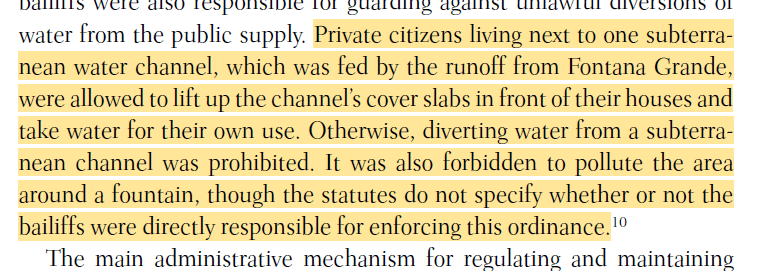
How handy is that!
That’s even easier than going into your garden to lift a heavy wooden bucket from a well.
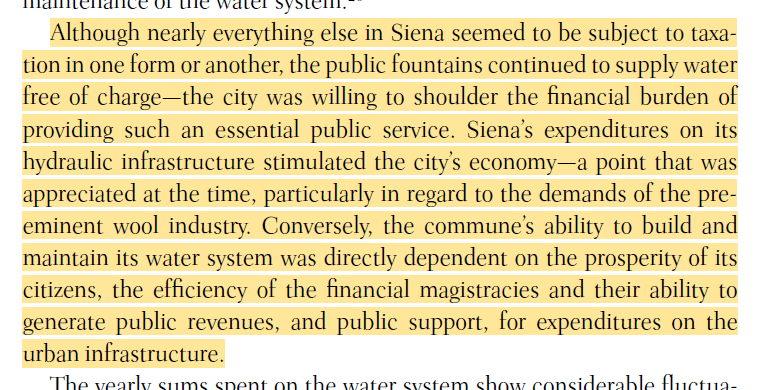
Does this sound like people who feared water?
Imagine that, the rulers providing an important service to the public for free… modern politicians should take note…
Of course they realised that clean water was just good for everyone, including the economy, but still, free is good.

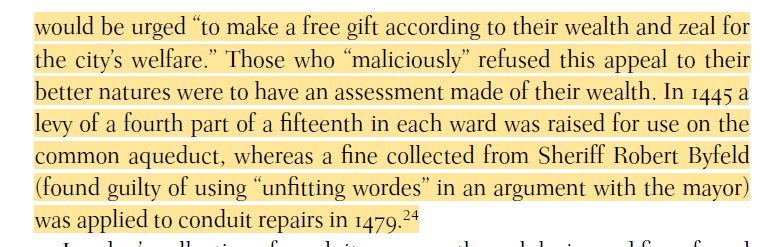
Another wonderful example of the wealthy being “urged” to make a contribution that would benefit all.
Again something some modern politicians could learn from…
I also like someone being fined for using “unfitting wordes”.S
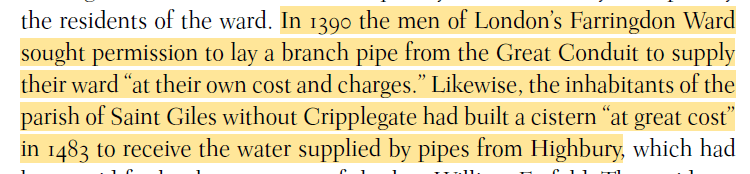
More evidence of medieval people really badly wanting clean water delivered to their houses or at least their neighbourhood.

Even prisoners were getting clean water!
PRISONERS!
From a cistern that provided clean water for a hospital!
Clean water everywhere!
As always, there are always people who do whatever they want, pesky medieval folk are sometimes a bit too much like us 😉

I think a bit more could have been written about this here, because a lot of people still believe the myth that medieval folks drank beer/ale in stead of water while in reality they drank lots of it, they just preferred the alternatives.

Good advice here, although I think that springwater is better than well water.
Note the advice to boil suspicious water.
I here have to correct the author a little bit, boiling water didn’t always cost extra fuel, time or much labour.
A fire was burning in most houses for much of the day regardless, you wouldn’t have to built a fire or use extra fuel to heat water, just put a jug or pot next or over the fire.
In many households there probably would have been a kettle or jug by the fire all day anyway, providing you with warm water at a moment’s notice.
To boil water from scratch you could use the ancient hot rock technique, by throwing rocks from the fire into a bucket of cold water you could get it to boil in seconds.
But there were of course some places where things were not great, like here.
What were the people in York thinking?
What a mucky lot.
Here we also see evidence of how some wells were no more than just a quickly dug hole, possibly not even properly lined, even though that was the law in many other cities.
But what kind of well is so big it can kill cattle?!
Oh no, women going outside, chatting and looking at pretty boys, maybe even talking to them, I wonder how many silly men were triggered by public fountains back then.
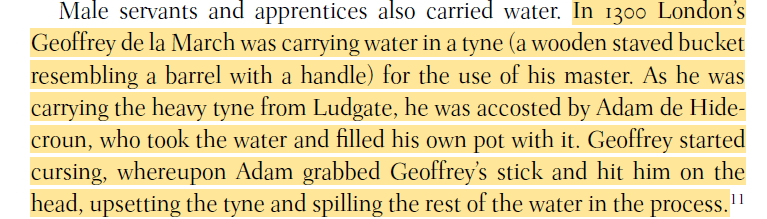
Adam, what a jerk.
Imagine being remembered centuries later for being a lazy bully.

Even there were water was not easy to come by, you could always get a water carrier to bring you some.
Probably a very cheap service, as anyone could do it, but of course in poor families this would have to be done by the children or maybe the apprentice who just gets in the way.
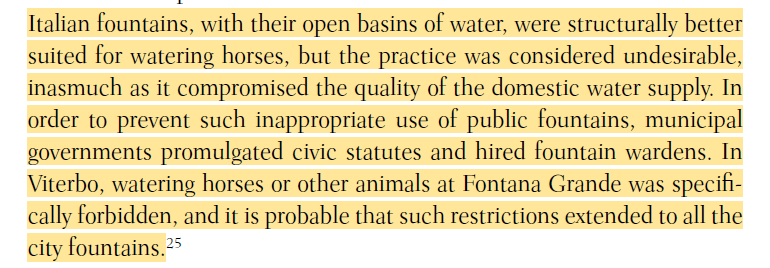
More evidence of medieval people caring about the quality of their water, without knowing anything about microbes, they still knew that sharing water with horses was not a good idea.
BTW there were also fountains developed that had a special overflow section that would fill a drinking basin nearby just for the horses.
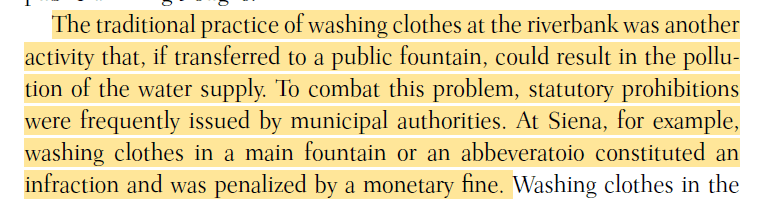
Yes of course people preferred doing laundry closer to home.
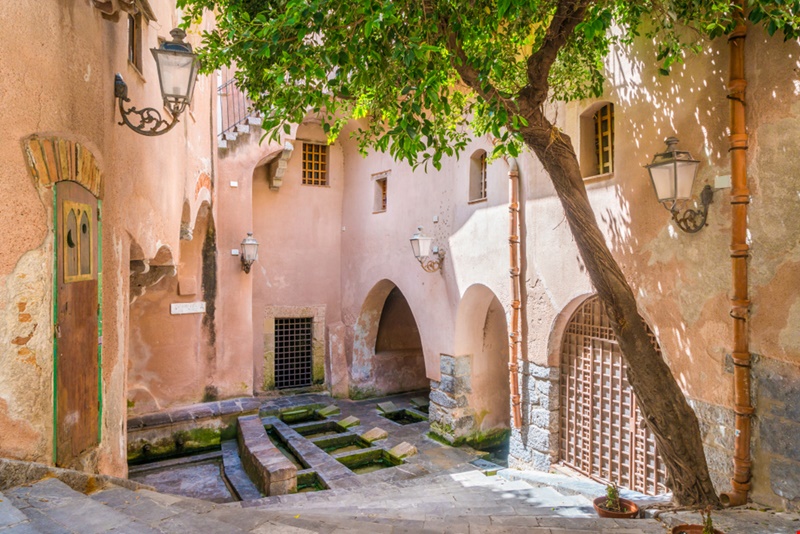
In stead of fining it in some places they just built something were laundry could be done without polluting the fountains.
Like here at the Cefalù washhouse in Italy, where through hydraulic engineering water would be redirected to this laundry spot, although what you see is from the early 16th century, it replaced an earlier one.
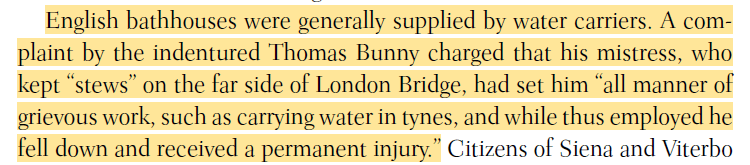
On to the bathhouses, one of my favourite subjects.
I’d love to know the source for the claim that English bathhouses had to be supplied by water carriers as that seems odd and unusual, many bathhouses were built in places where they could rely on easily getting water, they needed so much every day that carrying it from well to work seems like a strange choice.
Also the text shared here might just mean carrying water from a spout in the building or just outside to the tubs in stead of from a fountain to the bathhouse.
Side note: both bathhouses and brothels with bath services were called stews but were very different places you really don’t want to mix up when you travel back in time.
Don’t ask.
But them having the same name may in part be responsible for people thinking that all or most bathhouses were also brothels, looking at you Kingdom Come Deliverance developers 😉

I just can’t get enough of random medieval people only being remembered for being naughty.
Come on Ciampolino, Cia darling, what were you thinking?
Funnily enough I literally just saw a video on tiktok of tourists getting fined for jumping in the Trevi fountain.
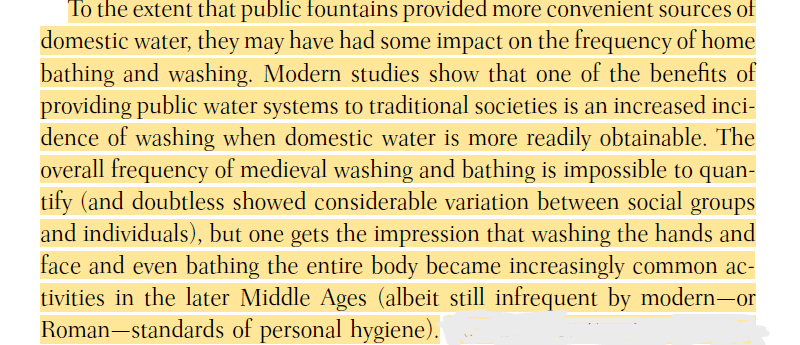
THIS!
This is what I’m always going on about.
When a historian decides to, usually for the first time, seriously study a very specific subject, we suddenly get a whole new perspective of all kinds of aspects of Medieval life.
Here we go, when we realise that medieval people had more access to water than we thought, the idea of it being extremely difficult for them to be clean becomes less believable.
I don’t agree with the authors last line though and here we have to keep in mind that the book was written over 2 decades ago, before ‘Community, Urban Health and Environment in the Late Medieval Low Countries’ by Janna Coomans, Het middeleeuwse openbare badhuis’ by Fabiola van Dam or Communal Health in Late Medieval English Towns and Cities’ by Carole Rawcliffe were published that all support the idea that bathing & washing was quite frequent, washing was a daily habit and people bathed weekly or more.
We also have to remember that the image of the Roman era often only applies to a few Roman cities and not the poorest people.
In much of the Roman empire people didn’t have the fancy infrastructure they had in Rome and even in Rome the city was so large but also overpopulated that the common people living on the 5th floor of an Insula in some slum had to walk down many stairs and quite a few streets to get to one of those nice public fountains or a public toilet.
Making it perhaps more believable that they actually did empty chamber pots from their windows, something medieval people are usually accused of.
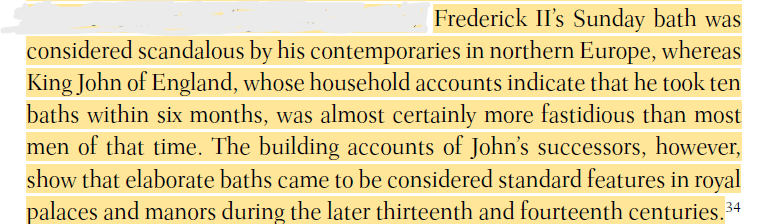
This bit I’m also not so sure about.
I’ve looked for contemporary sources where people were scandalised by his regular bathing and found none, I think the author here confuses the rumours spread as propaganda by Frederick’s enemies about his lavish lifestyle and perhaps assumes that this must have had something to do with his bathing.
But I’m yet to find evidence for it.
Come to think of it, I never found any contemporary evidence of him bathing weekly, earliest mention of this story I discovered dates to 1922!
The second part makes more sense, 10 baths a month is a bit much, that’s more than I usually have.
Weekly bathhouse visits were common but of course wouldn’t always involve an actual bath, but perhaps a steam bath and pouring warm water over yourself, which is pretty close to a bath when it comes to effectiveness.
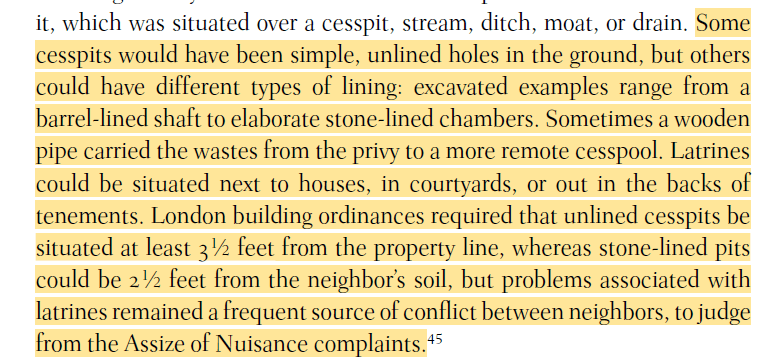
Toilet talk!
I won’t shout sewers again.

Oh no, poor Richard, what a way to go, what a way to be remembered till the end of time.
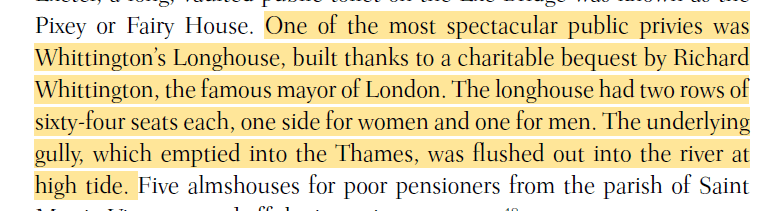
Look at that, massive free public toilets for men AND women.
Can you imagine ladies?
Someone actually thinking about us when building public toilets?
Again I can think of a few cities today that could learn from our medieval ancestors…
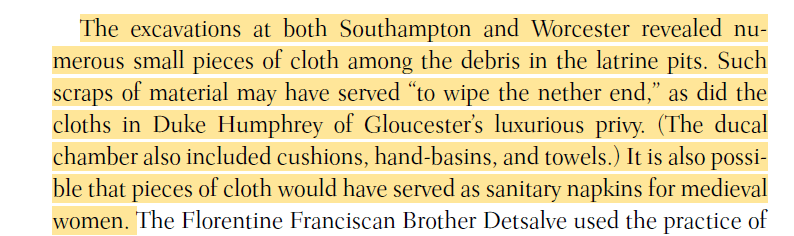
Archaeologists also found straw in cesspits, which made some wonder if this may have created a sort of dry compost toilet effect, reducing bad smell.
Although of course we won’t know if medieval people knew this, if they used straw on purpose for that or if it was just a happy side effect of wiping with straw.
You can read that paper here.
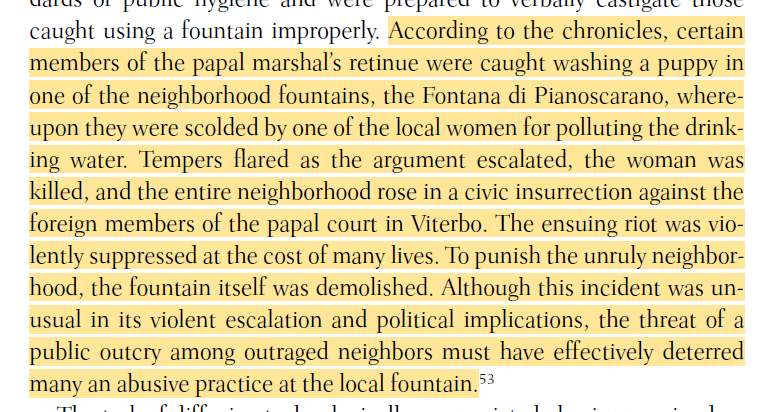
Goodness me, what a story!

We’re told that the Thames in Medieval London was filthy and used for dumping waste in, which is true but perhaps not the way we think as the story of Mr Bonet shows.
And yes, there are many stories of people getting into arguments, fights and even being killed over urinating or littering in public.

Important detail here is that although things decayed and were abandoned, they were also often replaced or adapted.
Something historians sometimes forget to mention when writing about the demise of Roman infrastructure…
I shared some of the bits in the book I found most interesting, predictibly these parts were mostly about how they debunked some of the stubborn myths about medieval hygiene.
But the book is of course about a lot more than just that, it goes into great detail about how all these water related things worked, developed, were used, etc.
It’s a very interesting book that I enjoyed reading a lot.
 Fake History Hunter
This books sounds great.
LikeLike